Crossing disciplines

Close-up of knitted pottery

Knitted porcelain for sale at the grocery store

Just out of the corner of my eye I caught it: a little porcelain ramekin with a pretty cable-knit pattern imprinted on the side, serving as a penny dish at my grocery store’s pharmacy counter.  What a lovely contrast between shiny, smooth porcelain and lofty, fuzzy yarn; between something made quickly in the thousands in a factory in China (I checked) and the hand-made cabled socks that take me hours to complete; between warm and cozy, and cold and hard.

It reminds me of my own brief foray away from knitting to pottery when I was living in New York years ago. For one winter, a couple of days every week I would leave my desk job on west 39th street and take the train up to the Upper West Side to work with and learn about throwing clay on the wheel. Afterward I would hop on the M60 bus and travel across the Tri-Borough bridge to Astoria, where I lived for a short time. While I usually took the train to get around the city, crossing the bridge seated up high on a bus was a treat: for once I could let my eyes relax and stretch beyond the confinement of the tall, gray buildings and let my gaze rest on the expansive lower Manhattan skyline across the river. The breathtaking view of the city, lit up after dusk, was all too brief. I felt like I had been let out of a cage and yearned for an entire day to stare at the wide, open expanse of the ocean, or perhaps the lake I grew up on in northern Minnesota.

But besides the meditative bus ride, there was something so satisfying about having just worked with mucky, sticky clay, about having created something literally from the earth with the force of my hands (so much more strength than knitting!). Working with the clay helped me forget the itchy feeling of sitting behind a desk all day under dark fluorescent lights, clicking a plastic mouse and keyboard and pushing buttons on the telephone. At my office job, there was nothing that required the absolute strength of my hands and forearms and even back muscles, nothing of the earth about shuffling light, dry sheets of paper in a temperature-controlled environment. Granted, I loved so much of my work – the wonderful people I worked with and met, the mission of the organization, carefully crafting language and taking phone calls that could directly help someone in need – but it was knowledge work, as it’s called, not visceral, physical labor, and I often romanticized leaving my desk job and devoting myself to clay full time. My best work at the pottery studio, however, was heavy and rough, and several bowls I had intended for the kitchen lost their meaning when I used non-food-safe glaze. Despite my failures with clay, I appreciate nice hand-made pottery all the better now – the smooth finish, the lightness, the beauty of the glaze.

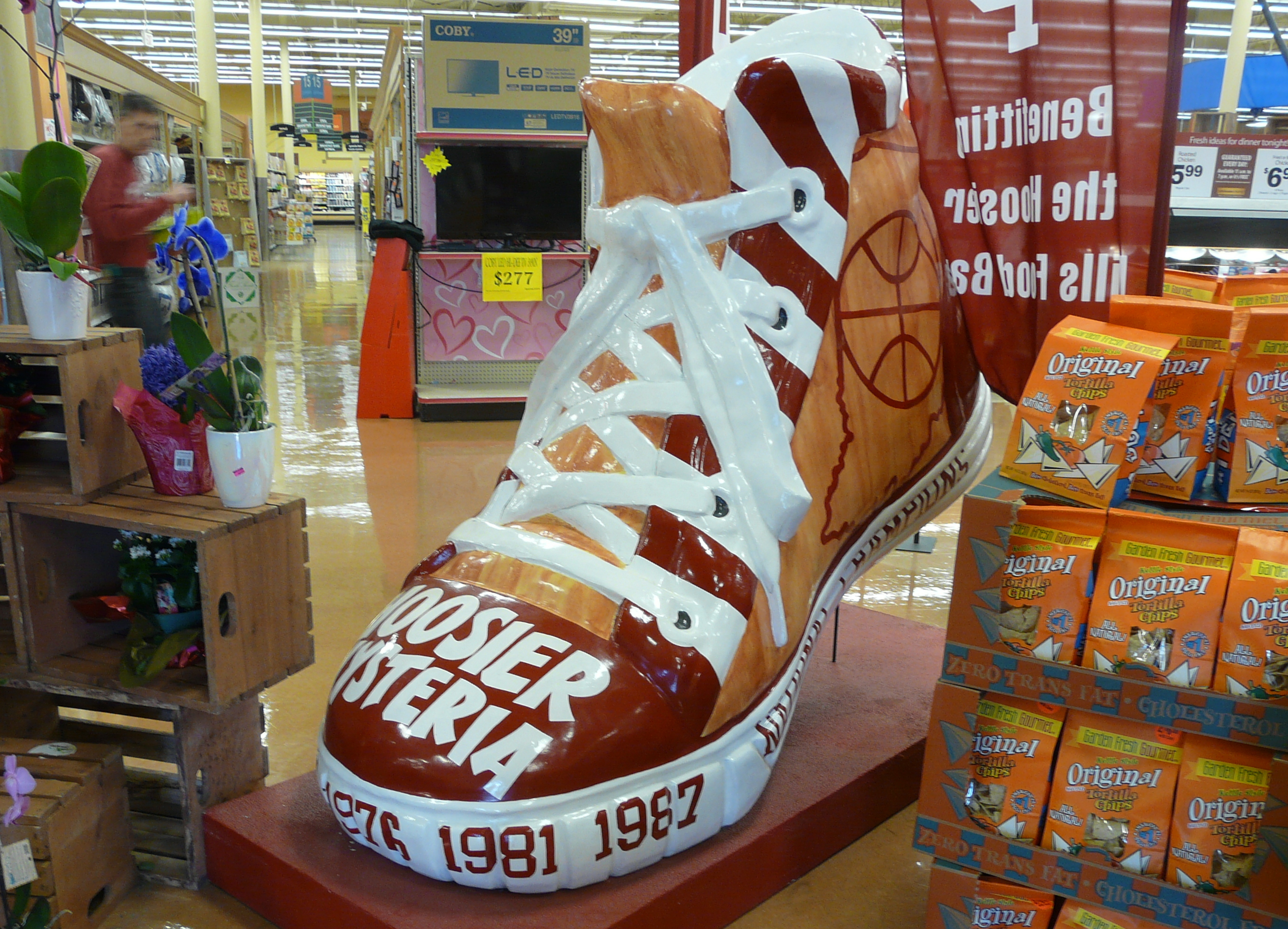
By the way if you’re thinking that my grocery store is pretty high-end for such a fine penny dish at the checkout, I’ll have you know that just around the corner from the pharmacy counter was this striking piece of ceramics (presumably hand-made, even, unless there are thousands of these around the country). Go Hoosiers!
P1050364

The life and death of an heirloom

I’ve been looking through some American craft magazines from the 1940’s, 50’s and 60’s and marveling at the changes in our culture since they were published: there are numerous patterns for lace doilies and lace edging for women’s handkerchiefs, advertisements for wonderful new types of synthetic yarn, and articles about how to make money by recycling tin cans into plates or selling mail-order greeting cards. It makes me wonder, what happened to all of the things that the readers – like my grandmothers and great grandmothers – might have made from these magazines?

I suppose they could have ended up in Mike Kelley’s 1987 piece, “More Love Hours Than Can Ever Be Repaid,” which I saw in the 2011 Walker Art Center exhibit The Spectacular of the Vernacular. I went there to see two beautiful sculptures by my brother, Aaron. The exhibit “considers how artists have claimed homemade handicrafts or rustic aesthetic traditions in new ways.” (PBS.org) Kelley did that with his huge tapestry of old, discarded hand-made dolls, stuffed animals and afghans.

To me, his piece was looking at and questioning the value and necessity of homemade things in our culture. As a life-long knitter, I took it personally. The bears and afghans were familiar and reminded me of the crocheted and knitted things my grandma, neighbors, and other family friends made for me and my brothers in the 1970’s and 1980’s. More importantly, only a few weeks before seeing the Walker exhibit I myself had given a hand-knitted bunny to my four-year-old daughter for Christmas.

IMG_2782

While my daughter liked receiving it – she proudly remembered me working on it – I noticed several days later that she hadn’t played with it yet, even though the wool was locally spun (Bemidji Woolen Mills); the dress was made from luxurious, somewhat expensive alpaca yarn; and I had spent hours making a swatch, planning out the yarn, and knitting and piecing it together (I hate piecing). It had been a labor of love for my child. But despite my best efforts, the bunny didn’t really turn out to be as “good” as store-bought: it wasn’t as soft and cuddly as her plush bears, it had no buttons or batteries. So when I saw Mike Kelley’s piece, I wondered: will my daughter’s little bunny end up discarded like these other imperfect, scratchy homemade bears and blankets? What becomes of the imperfect, useless, scratchy, acrylic or wool hand-made things when there are perfect, shiny machine-made products that often become more loved, more used, more necessary to our daily lives? Is there a general lack of quality craftsmanship that is missing in our craft culture in America, where just the fact that something is handmade and not made at a factory makes an item not only a novelty but an heirloom as well?

These questions, I suppose, compel me to try to make things better. That is, if I can make something that is really beautiful, really special and fits just perfectly, it will be as good as factory-made and store-bought and will be loved and used – and keep it from ending up in the dustbin. Ultimately, though, I’m going to say that it doesn’t really matter what happens with my knitting after I’ve finished it and given it away. I love the knitting process and the moment of giving something I’ve made, and of course I would like to know the person appreciated it and could use it. But after I’ve given it away, it is no longer for me to decide. And I am only as good as my latest work, right? So I will keep trying to make better bunnies and socks and scarves…

And as for my own family’s many “heirloom” sweaters, afghans and doilies, I am happy to say that, after a few button and stitch repairs and despite the fact that they are acrylic (I prefer wool) my husband’s grandma’s sweaters keep us beautiful and warm all winter and my grandma’s afghans keep my daughter cozy at night. The dozens of my grandma’s colorful and intricate hand-crocheted doilies, however, remain piled up in the drawer of my china cabinet. At least they have each other’s company: the bunny remains on my daughter’s dresser, well dressed, but alone.

With love, from Latvia

After being away a few weeks during Christmas vacation I came home to three pieces of mail from Latvia, which is always a happy event: a postcard from a friend and fellow knitting enthusiast visiting Latvia, and two cards from Latvian friends.

The cover of the postcard is a picture of, appropriately, a series of traditional knitted mittens from the 18th century to the beginning of the 20th century, held at the National History Museum of Latvia:

We’re nearing the end of our Christmas travels – we fly back to B—- tomorrow. Riga has a series of Christmas trees all around town. There are saws (handsaws) put together in the shape of a tree and another that had bicycle-powered lights. We went to an organ concert today and the church was full! We had no idea organ music was so popular with Russian tourists. I’ve had lots of fun looking at yarn and knitted items both here and in Tallinn. Christmas markets are still going (tomorrow is Ephiphany, but Orthodox Christmas Eve). Lots of wonderful food!

I remember going to Riga on weekends, a three-hour bus ride from the little town I lived in out in the country. We would get farm-cheese stuffed pancakes, go to American movies, browse the windows of the expensive European and Russian stores, all while walking under the impressive art nouveau buildings towering above us. After shopping the outside craft markets by the Dome Cathedral, I remember going to a nearby art museum (I wish I could remember the name) to look at the artwork of the textile artist Edīte Paula-Vīgnere, the sister of the beloved Latvian composer and musician Raimonds Pauls. In the pieces I remember, she wove wool and linen and other materials to make sculptures, collages, and tapestries. Here is a picture of one I found online: “Saudzēsim dabu”  I remember that it was so hard for me to believe that she made and showed such art during the Soviet period, that is, starting in the 1960’s (and up to today). I saw her artwork as very representative of Latvian culture, with all of that wool and linen, glorifying nature. How did the Soviet authorities not question this work that, to me, looks like an expression of national identity, which they tried to repress in all aspects of life then? I do not know Paula-Vīgnere’s story; maybe I read too much into all of this.

And in one of the other letters, from my dear friend Māra, poetry:

Kad skaistu, baltu ziemas sarmu
no kokiem nopurina vēš,
Lai Jaunais gads nes īstu laimi
Un jaunus sapņus īstinibā vērš!

When the beautiful, white winter hoarfrost
from the trees is shaken off by the wind,
Let the new year bring real happiness
and turn new dreams into reality!

Vær så god!

My double-themed Christmas knitting fervor this year is almost complete: I sent off my niece’s white knit-in-the-round-with-DPNs hat (picture in the last post); the reversible double-knit potholder for my sister-in-law is pretty, but too small and better suited as a washcloth; the knit-in-the-round socks are beautiful but also too small for my mom, so that the lovely patterned reinforced heel slides onto the foot more than it should.  Now they will go to my sister-in-law for her January birthday and I will make another pair for my mom – then, finally, the knitting double marathon will be over, for the time being.

IMG_4958

Pattern: TPHPE by Heather Zoppetti, free on Ravelry

IMG_4953

Pattern: Toe-up Socks by Leah Mitchell from “More Last-minute Knitted Gifts” by Joelle Hoverson

I can’t help but knit something special for my mom for Christmas. It is for her the most important event of the whole year. It is a time that brings us all back to her childhood, growing up on a dairy farm in a town of Norwegian immigrants where her mother always made the traditional Norwegian dinner at Christmas, and which we continue to make every year: lutefisk, lefse, Swedish meatballs; rømmegrøt (a cream porridge) and yifta.  Beautiful sugar cookies – krumkake, sandbakels, fattigman, rosettes, and drømmer cookies – were made by my grandma, my great aunt Imogene, and other relatives, neighbors, or members of the Norwegian Lutheran church where my grandma played organ for more than forty years.  At the dinner table on Christmas eve, after church, my grandma and grandpa passed the food with a “vær så god”: here you go, your welcome. Tusen takk, is the reply. After dinner we sang with my mom’s sisters Silent Night, Oh Come All Ye Faithful, and Jeg er så glad hver julekveld (I am so happy on Christmas eve) around the piano, all of the songs that my mom now puts on repeat on her radio for most of December and probably January too.

IMG_3953

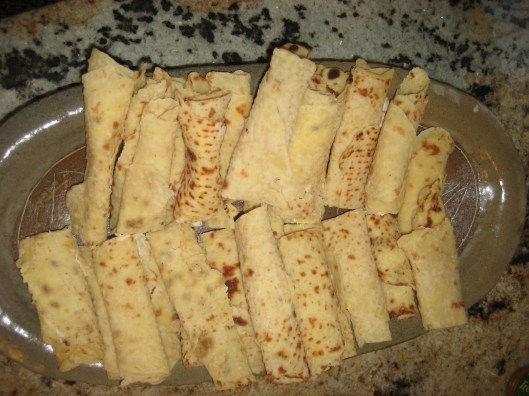
Lefse: like a tortilla made with potato and flour, buttered and rolled up

IMG_3534

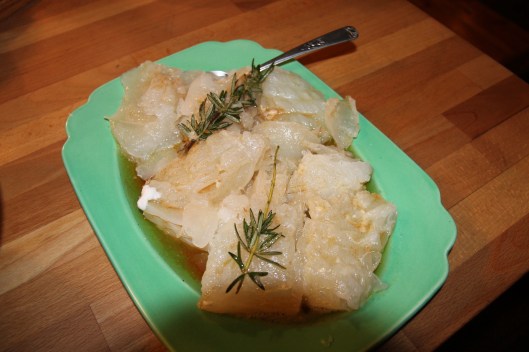
Lutefisk: cod soaked in lye, boiled several hours to remove the lye, and served with melted butter

IMG_3951

Yifta: cranberry sauce, whipped cream, graham cracker crumbs

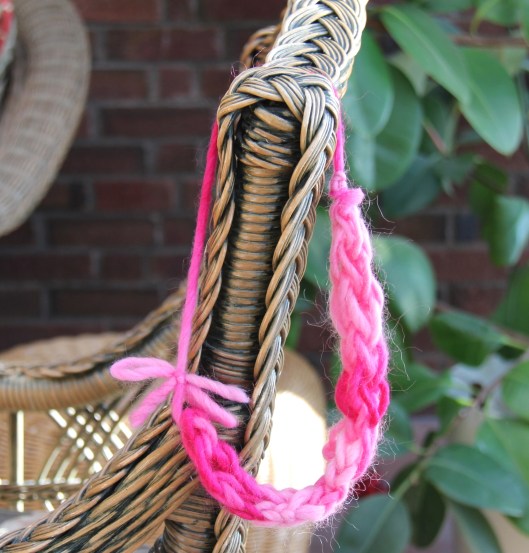
With such rich traditions and meaning I can’t give my mom something simple. And so I knit for her, though not always perfectly. Happily, my daughter saved my too-small-sock  gift by giving my mom the best knitted surprise of all: a pink wool necklace which she knitted on her little, five-year-old fingers. Vær så god, mom!

IMG_3620

Twofers

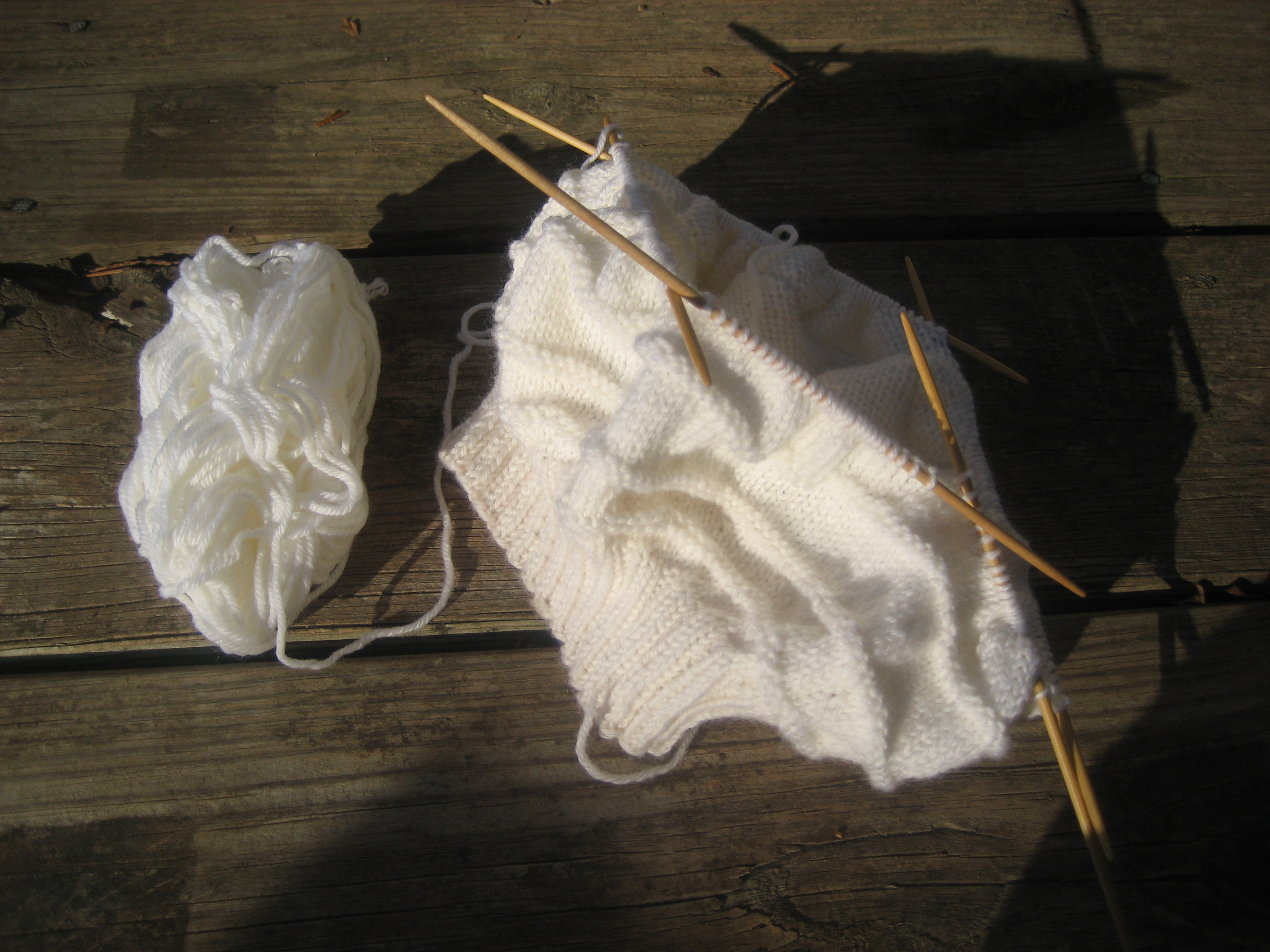
Double-pointed needles have officially taken over all of this year’s Christmas-gift knitting, as well as any bit of my free time: Now that it’s the end of November and I have time for only one or two more knitting projects to give, I have been knitting constantly and obsessively – knitting for a deadline puts me in a crazed state – and so I am cutting back on my knitting-reading for the time being and am only letting my fingers change pace here to do a bit of typing. Then back to knitting. 

I am determined to not repeat the same mistake I made the last two years by finishing my gifts only minutes before wrapping and giving (and sacrificing  the time for much-needed blocking).  Couldn’t I just make a whole bunch of small things? I made one lavender-filled sachet, above, from the book “More Last-minute Knitted Gifts” by Joelle Hoverson (STC Craft, New York: 2010), but after finishing it I felt dissatisfied: I wanted to make something more substantial for my recipients, like a hat or socks.  There is a beautiful pair of socks later in the book, also using DPNs. And there is my friend Leora’s  several Rowan and Kim Hargreaves books which she lent me recently and which have the most fashionable hats, of course (and where I could apply my DPNs).

“Robin” beret from “Thrown Together,” by Kim Hargreaves (Kim Hargreaves, 2008). The pattern asks for Rowan Classic Cashsoft 4ply but I used a very soft Dalegarn wool. 

So my new gift plan is set. But why double-pointed needles? Why torture myself with sharp needle points poking into the palm of my hand, stitches threatening to surreptitiously sneak off either end, tiny 0’s and 1’s bending and breaking under the strain?  And then there is the ubiquitous – condescending? – reminder in all such patterns: “Be careful to not let the stitches twist when casting on” (as if we had any control over such rogues).  All of this to avoid sewing. And to not have to purl so much… But there’s more to it than that, I think.  More than just getting the use of two needle points for the price of one (twofers!). I realized why I like DPNs – that I romanticize them, I suppose –  while recently browsing my latest knitting-history book, “Knitting America,” by Susan M. Strawn (Voyageur Press, 2007).  Double-pointed needles were really the only way to knit in the past, as you can see in the book’s 19th and 18th century grainy, spotted black-and-white photos: women wearing their Sunday best and sitting formally in carved wooden chairs, or in their aprons and sitting on the porch or in a field, are holding knitting that is always double-pointed, in-the-round.  They bring to mind one of the oldest pictures of knitting which dates to the beginning of the 1400’s and shows the Virgin Mary knitting, of course, with DPN’s in the round (Madonna Knitting, by Bertram of Minden). So when I knit with these needles too, it seems there is some connection I have with knitters of so many centuries ago. There is something rustic and genuine about knitting with something so simply made out of wood; maybe the struggle with the points and stubborn stitches makes it more so.

IMG_4932So the hat has turned out beautifully, as seen above.  Unbelievably – or not, really – I have to admit that I didn’t read the pattern very well and only assumed I was to knit the hat in the round. It turns out that the directions are to knit flat and sew up. The only problem I see with my hat is that at the corners where the needles met, and where the stitches were stretched out a bit, there is the slightest jog at the ends of the purled rows. Other than that the hat just needs the pom-pom on top (the color to be determined by my recipient’s coat). Incidentally, I do have a similar yarn in red: I’d have to transpose the pattern for the larger gauge, but the hat is so cute and was such a delight to knit that I would do it again. Maybe I should have done some double knitting while using my double-pointeds? Now that would have been a real Twofer.

The Golden Age of Homespun

In my last post on Swedish knitting I suggested that my next read would be on knitting in New Zealand. But another book caught my eye recently, one about the life of American pioneers, and I haven’t been able to shake it.  I intended for this blog to be mostly about foreign things – posts in other languages or knitting traditions from around the world – but I’m also a girl from a small, Midwestern town, and I think about it constantly: about what kind of place it is, about how culture and community grow there, about how it compares to other places here and abroad.   

So it was fitting that I found this book at a used book store in what I consider the capital of Midwest America – Chicago, were I was visiting last January to help my sister-in-law with her research on Midwestern food and cooking. By “help” I mean that we had to eat at several of the loveliest (relevant) restaurants within a matter of a long weekend. By the time we got to Avec, I couldn’t bear the thought of even one bite of the pièce de résistance – chicken with pomegranate sauce – much less my usual love, dessert. It was a kind of torture. In between eating, we walked. I was happy to be kid-free for a few rare days and I relished the selfish, decadent time. A book store was the perfect destination for us: we could get lost in our own thoughts, in our own books, killing time until our next meal reservation. With that kind of open, luxurious time, I was desperate to sink my teeth into something fulfilling, something about my great loves of knitting or languages ideally, when I happened upon this grand title bound in mustard-yellow cloth: “The Golden Age of Homespun” by Jared Van Wagenen, Jr. (Cornell University Press: Ithaca, New York. 1953.). 

Reading “The Golden Age of Homespun” is like having a guided tour through an antique shop or a farming history museum. Our guide – who wrote the book at age 82 – fondly relays the stories told to him by his parents, grandparents, and other old-timers about what life was like during the earliest colonial period, through the pioneering days, and up to the Civil War and the beginning of the machine age. He defines this era in terms of home-processed textile because the art of processing one’s own yarn and fabric became essentially lost at the end of this period. While other farming tools and practices of the time were recorded in farm journals and while kitchen and cooking arts continued into subsequent generations, the art of making fabric at home died with the advent of machines. He writes (and you can see how pleasantly he writes):

“I have not found it possible to gather much information relative to the precise technique of the domestic manufacture of wool. Those elect women who were with us when the homespun age drew to a close and who could have been given such ample and illuminating testimony have since gone the way of all the earth. In the great libraries are shelves of books dealing with modern woolen manufacture, but only here and there can be found a phrase that has any reference to the homespun art. While our earliest periodical agricultural literature has a great deal to say concerning the care and breeding of sheep, it has hardly a word concerning the manufacture of their fleeces. It is a melancholy reflection that a great amount of skill and knowledge concerning one of the most fundamental of household arts has left behind no written word or even tradition.” (page 261; my italics)

His references to census statistics show the extent of the work that women were doing at this time. The 1845 census shows that more than seven million and ninety thousand yards of cloth had been woven at home in the previous year (p.266). (Throughout the book he generally talks about New York state, where he and his family farmed). Also according to the 1845 census, pioneers in New York State grew 46,000 acres of flax; by 1855 it dropped to 13,000 acres and after the Civil War it was not a significant crop in the census any more (p.251). Cotton of course replaced linen around the time of the Civil War; cotton was cheaper and easier to grow and to process on machines.

I think what strikes me here is the same theme I ended with in my last post on knitting history, that is, the failure of historians to capture the everyday work of women in history.  The author of “The Golden Age of Homespun” defines an entire age by what was largely women’s work. The transition to purchased cloth from homespun was dramatic and completely life changing for women, and consequently the whole family: whereas families once grew their own flax and raised their own sheep in order to spin the fibers into yarn to be woven or knitted into their family’s clothing, there came a point where it was more economical to make money for purchasing cotton cloth already made. How much activity and daily life changed within a matter of decades! And how little we know about it today!

By the way, speaking of purchased, machine-made cloth, that was the other thing that my sister-in-law and I did in our beloved Midwestern mecca: browsed vintage clothing stores. I was happy to find, in all of my luxurious, non-spinning, non-weaving, non-child-rearing time, a fun little inexpensive top made out of rayon, the natural but laboratory-made fabric that the pioneers certainly would have marvelled at. They, like me, would have also marvelled at the chicken with pomegranates, the memorable Wild Boar Sloppy Joe at Longman & Eagle, and the “fried naked cowboy” egg salad (with oysters) at The Girl and the Goat. 

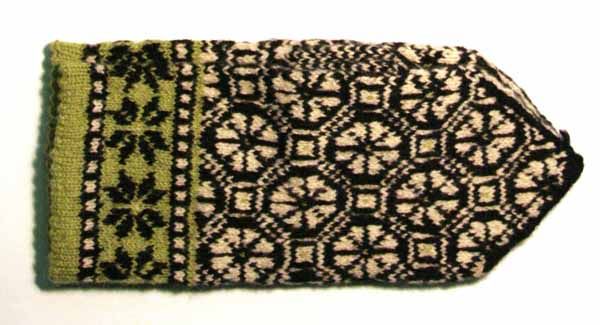
Dainas 4198, 4200, 4201

Mitten from Vidzeme region of Latvia. Image from website for 2006 NATO Summit in Riga, Latvia http://www.rigasummit.lv/en/id/galleryin/nid/120/gid/3698/

As the weather in southern Indiana has finally turned cold for good, it seems, it’s time to break out the mittens – and three more Dainas to accompany them (see my first post for more).

4198.
Bitīt’ liela, bitīt’ maza,
Bitīt’ šūnu šuvējiņa;
Meitiņ’ liela, meitiņ maza,
Meitiņ’ cimdu adītāja
1178, 658

Big bee, little bee,
Bee the honeycomb seamstress;
Big girl, little girl,
Girl the mitten knitter

4200.
Aitiņ, mana rogulīte,
Pelēkām kājiņām;
Tur adīju skaistus cimdus,
Tur – pelēkus mētelīšus.
1551, 7230

Dear sheep, my little ear,
with the gray little legs;
There I’ll knit pretty mittens,
There – a gray overcoat.

4201.
Ja man būtu balt’ aitiņa
Jel bitītes lielumā,
Es adītu raibus cimdus,
Kādus pati gribēdama.
914, 2567

If I had a little white sheep,
The size of a little bee,
I would knit motley mittens,
the kind that I would want myself.


Exclusive hand-knit sweater!

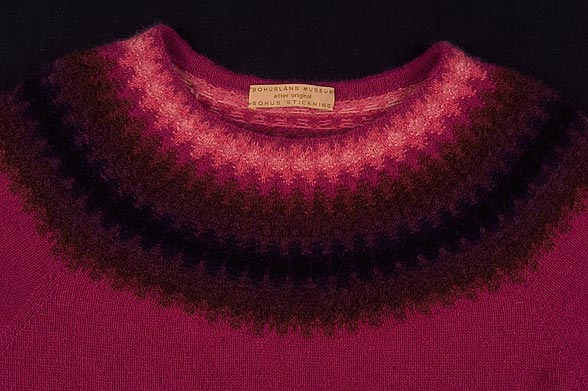
“The Red Palm” Design: Kerstin Olsson, 1967; picture posted with permission from Bohusläns Museum

Last week I opened up the most recent Garnet Hill catalogue and saw a gorgeous bobbles & lace knit sweater next to this caption: “E/Hand-Knit Sweater EXCLUSIVE Lusciously soft Italian blend of acrylic/wool/viscose/alpaca… Italy/Imported….#27525 $88.” It makes me want to know – just who is hand-knitting these sweaters for such a low price? Or is that just the name of the “style” of this sweater… After I count up the hours it takes me to actually knit something – I’m a moderately fast knitter when I get going – plus the time in designing or just making a gauge, plus the cost of the yarn: it is priceless!  (Something I usually only start to realize when buying insurance for my precious hand-knitted items to be sent in the mail.)

The subject of hand-knitting for sale brought to mind the knitting book I most recently finished: Wendy Keele’s history of “Bohus Stickning,” a Swedish knitting business that created so many beautiful and unique hand-made sweaters from the 40’s through the 60’s.  The business was started for women in rural, southern Sweden (Bohuslän) who were struggling to make ends meet following the depression. In 1937 the women approached Emma Jacobsson, the wife of the governor of Bohus, to look for a cottage industry for the women to make money while taking care of their children, homes and farms. Emma settled upon knitting, something that the women in this region could already do and that required few tools. She found innovative designers and encouraged them to create new, interesting, and fashionable sweaters, hats, and mittens that were eventually marketed around the world, most importantly to wealthy foreigners. She demanded the highest quality of wool, paying higher than usual prices to the best wool producers, and she demanded perfection in the actual knitting and sizing. Bohus Stickning grew and thrived as the economy improved in the 1950’s, but by the early 60’s demand fell and in April 1969 Bohus ceased operations.  So much had changed in that period of time as cheaper, machine-made sweaters became much more easily available and fashions and styles had evolved.

While reading I was struck by the story of the women who actually did the knitting.  After Bohus closed, some of the knitters wrote letters of gratitude for Bohus and all that it gave them. One wrote, “It will be a big loss not to get Bohus knitting anymore. It had been so interesting and nice when sitting alone…” (Keele, page 51). This lovely glimpse into domestic life of the past is something that I think about often as I raise my two children and struggle to meet that happy point between taking care of them and meeting my own professional, personal, financial, etc. needs.  I wonder how my ancestors – several of them from nearby Norway – managed to cook and preserve and farm while raising children who constantly get into things and need so much. On top of all of that, the Bohus women were knitting perfect sweaters for others to make a little extra money; they were docked pay when the sizing was off or there was a mistake in the pattern, Keele writes. When I read political histories about important actors and decisions, I miss this part of the story – the day-to-day life of people in a particular time and place, especially of the people taking care of hearth and home.

The larger history during this time and place is striking too: Bohus Stickning was founded in September 1939, the year that Germany invaded Poland and effectively started World War II in Europe.  If Sweden would have taken sides in World War II – the country was neutral – the knitted goods made by Bohus Stickning most likely would have supported the war effort. Of course Bohus was not unaffected by the war, Keele explains; at one point the Swedish government required a permit for wool to be exported and spun in Finland where Emma sent some of her finest wool; later, the Finnish government banned all wool exports. Still, I can’t help but think of the home knitters in New Zealand during World War II who supported their troops by knitting them thousands of socks made from their country’s wonderful wool of course. (I read about this in Heather Nicholson’s book, The Loving Stitch: A history of knitting and spinning in New Zealand, published by Auckland University Press, 1998.) How differently Bohus Stickning might have developed – how different those women’s lives would have been! – had Sweden changed political course.

From Garnett Hill, to Sweden, to domestic life, to politics, and now to New Zealand. It looks like I’ve chosen my next book to read!

Photo used with permission from Interweave Press. Photo by Joe Coca, © 1995 Interweave Press and Joe Coca, http://www.interweavestore.com/store/Search.aspx?SearchTerms=Keele

“Poems of color: knitting in the Bohus tradition,” Interweave Press, 1995; by Wendy Keele  http://www.interweavestore.com/Knitting/Books/Poems-Of-Color.html

Multitasking

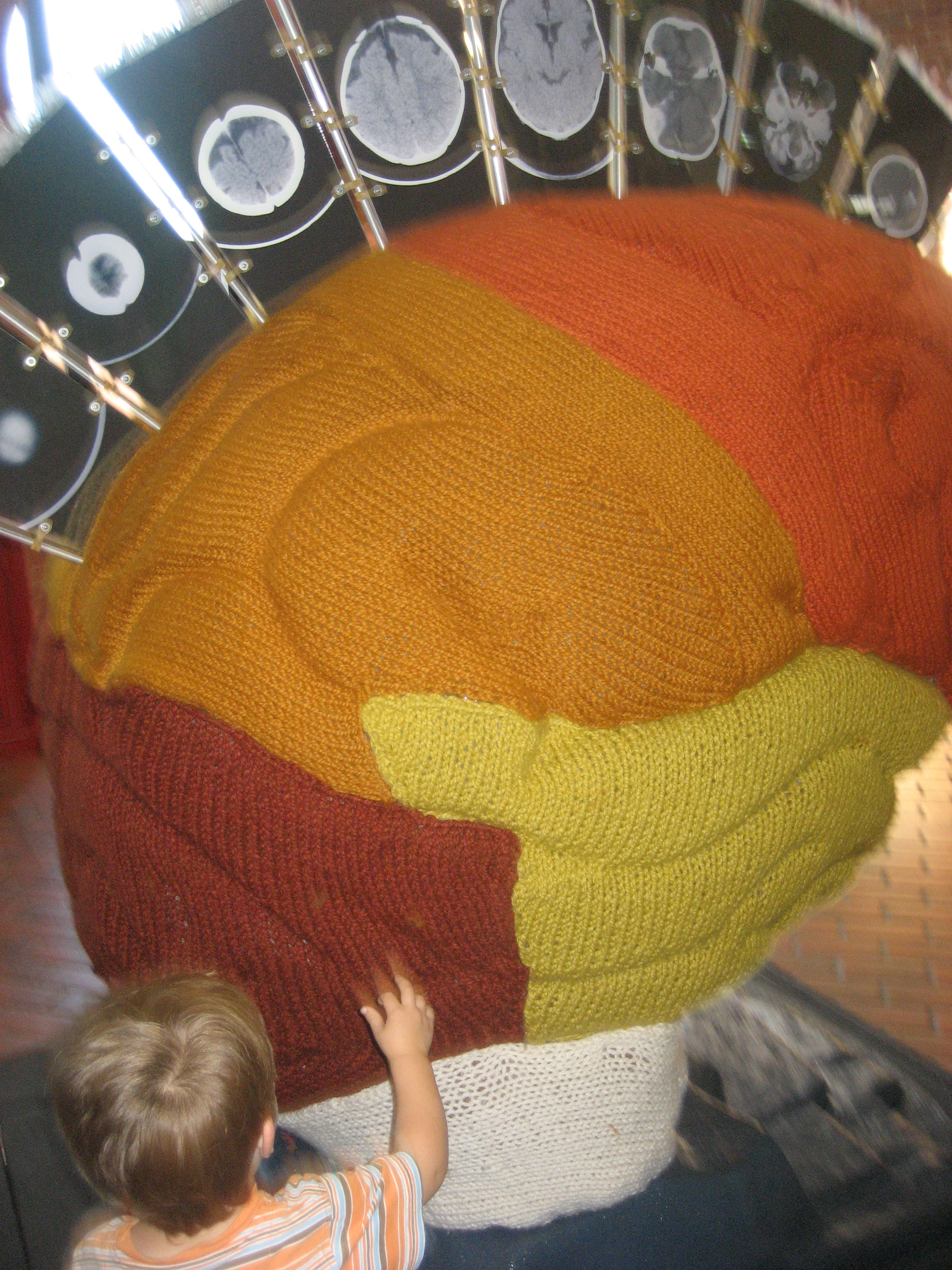
Brain no. 7, designed and knitted by Yara Clüver and Althea Crome, from “Brain Extravaganza!” (Jill Bolte Taylor BRAINS, Inc.). http://www.jbtbrains.org/ Picture taken in Bloomington, Indiana.

We’ve learned from research now that multitasking is ineffective, that it only feels like you’re getting so much done talking on the phone and e-mailing and writing a memo at the same time, but in fact you would get all of those things done much more quickly if you did them individually. Obviously, these researchers have not studied knitters – the ultimate in successful multitaskers.

Take my most recent multitasking challenge: the bedtime ritual these days ends with me sitting in a comfortable chair outside of the kids’ bedroom doors while I sing and knit, a softly lit lamp behind me. The idea is that they are soothed to bed and don’t terrorize their rooms while I get something done! Unfortunately, my singing repertoire has been getting stale and I’m currently knitting the cutest cabled Debbie Bliss booties/baby socks, which means that 1) I need printed lyrics on my lap to learn some fresh songs and 2) I’m trying to follow detailed directions for ankle and foot shaping, it being a typical DB pattern that has to be sewn up (i.e., it’s not as friendly to knit for me as it would be in the round).

One of my “interruptors” touching the beautiful Brain no. 7, designed and knitted by Yara Clüver and Althea Crome, “Brain Extravaganza!”

As many knitters would agree, knitting while talking is no big deal, in fact it helps move along the conversation at times. Sure I might make a mistake here and there, but I would do that if I were knitting and just not concentrating very hard too.  Repetitive knitting  is often left to the memory of your hands, like when you forget how to do a certain stitch or cast-on and you close your eyes to let your hands figure it out on their own. Letting your hands do the work leaves plenty of room in one’s brain to sing or talk or read a book (a la Elizabeth Zimmerman’s recommendation). So it is possible to knit and sing at the same time, but what about knitting detailed instructions while singing?  Apparently, it is possible. I’m even amazed while I do it – I will sing an old, familiar song and not get lost in the lyrics while at the same time I am counting stitches, doing short rows, and following decreases that differ every row.  How can our brains do this, how can they concentrate on two different things at the same time?  Throwing new lyrics in to the mix has slowed me down a little – I may count the stitches several times over while I’m looking at the paper – but after a second I’ll be back knitting! Proof that multitasking is possible and successful.

My zen-like concentration is short-lived, however. One of the kids invariably  gets up and has to go to the bathroom, or needs water, or didn’t say goodnight to daddy, or… the list goes on. Each time, my thoughts of singing and stitches are completely obliterated to the point that I don’t even know what side I’m knitting on, I don’t even remember what song I was trying to learn. If I would stick to just one thing, maybe I wouldn’t get so lost when interrupted…

The socks I made from the Debbie Bliss pattern (but without the cuff). Unfortunately I forgot to take a picture of the light pink socks for baby Ida. These are for Emory, hoping he doesn’t outgrow them too soon.

Anna Karenina in Las Vegas

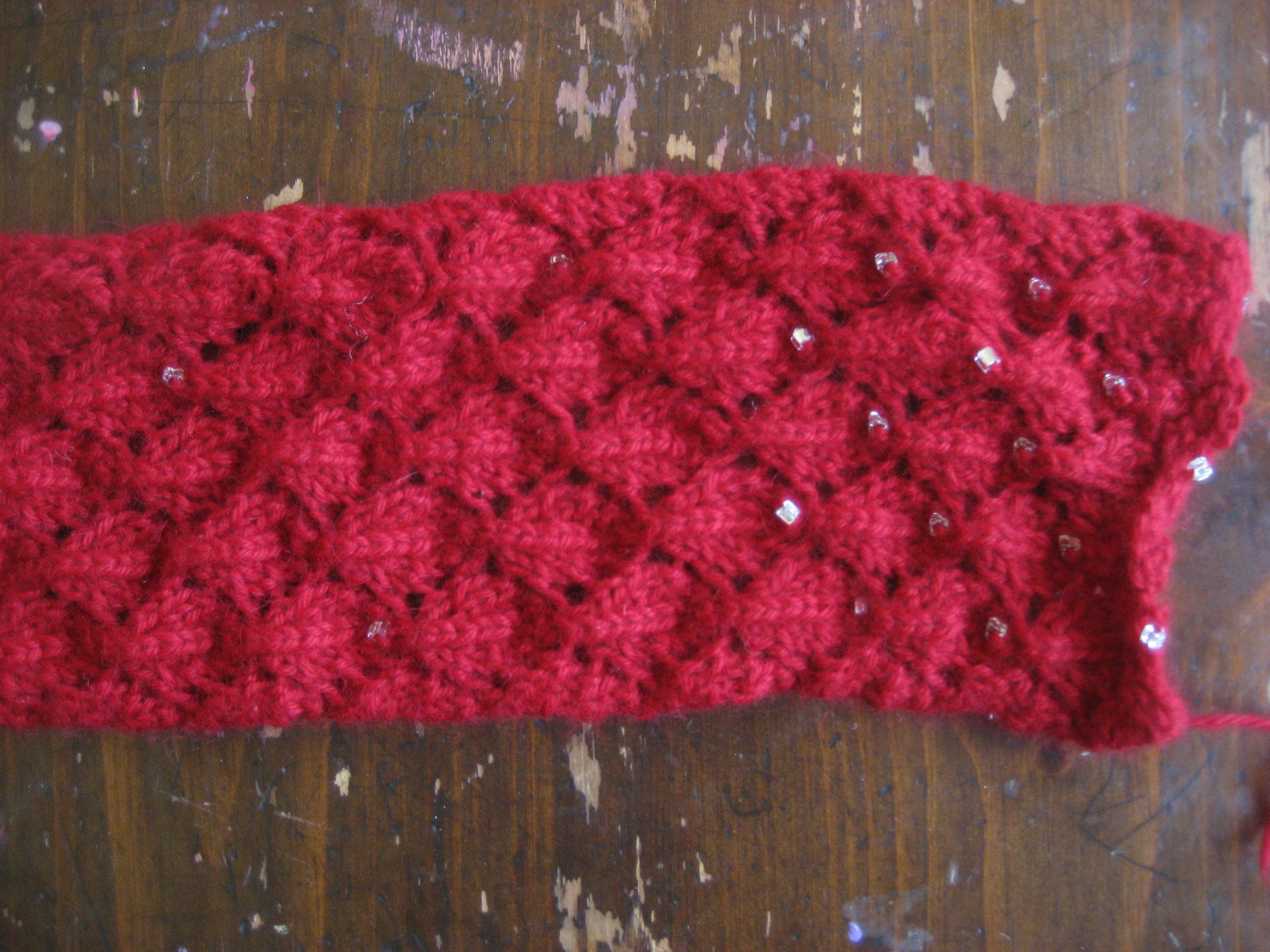
I recently finished knitting this lacy red alpaca scarf for my best friend.  She and I grew up next door to each other in a quiet, woodsy spot just outside of a small town in northern Minnesota.  She’s not really the knitting type, so I hesitated in knitting something for her for a while. She loves bright, fun clothes and jewelry – my knitting is usually earthy and a little dowdy – and during the long, cold Minnesota winters she and her husband love to go to Las Vegas, I imagine to get dressed up and go out on the town. With that in mind I set out to make something luxurious and with enough bling to complement the bright lights of their beloved dessert oasis.

Thinking of her while I knit this, one thing I was reminded of was her great appetite for fiction.  Since we were little she has always been a voracious reader, while I haven’t read anything other than non-fiction parenting or knitting books in ages.  But I used to read more and I miss a good novel.  I especially miss that one terribly hot summer in college when I was immersed in Anna Karenina, getting a sunburn on the dock but believing the pain was actually frostbite because I had been sitting for hours in a snow-covered barouche crossing the Siberian tundra…

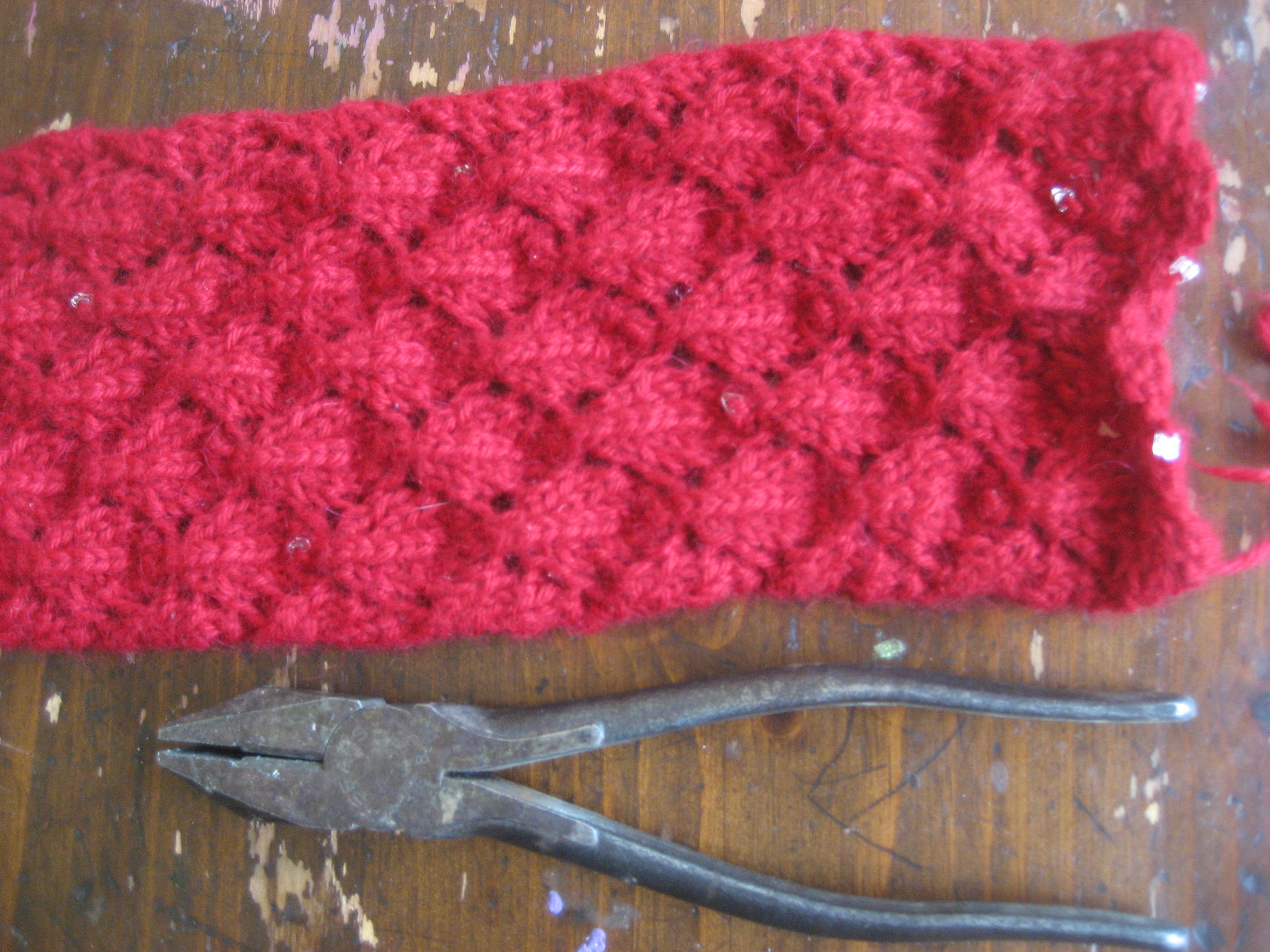
Like our troubled Russian heroine, this scarf has a bit of tragedy to it. I started it intending to blanket it with little glass beads,  but after several pattern repeats it was too busy.  

Not wanting to start over with the knitting, I continued the scarf but just added the beads intermittently.  Then I took a rusty pair of pliers and cracked the half-dozen beads I didn’t want.

Like Anna, the lovely, delicate scarf did not deserve such violence – but it does look perfect now!

Anna Karenina / Las Vegas scarf pattern

Needle: Size 7

Yarn: DK weight – Baby alpaca, 2 skeins

Beads: Darice Toho Premium Beads (glass-type beads, mine are from a Michaels store)

Guage: Approximately 17 stitches per 4 inches in lace pattern

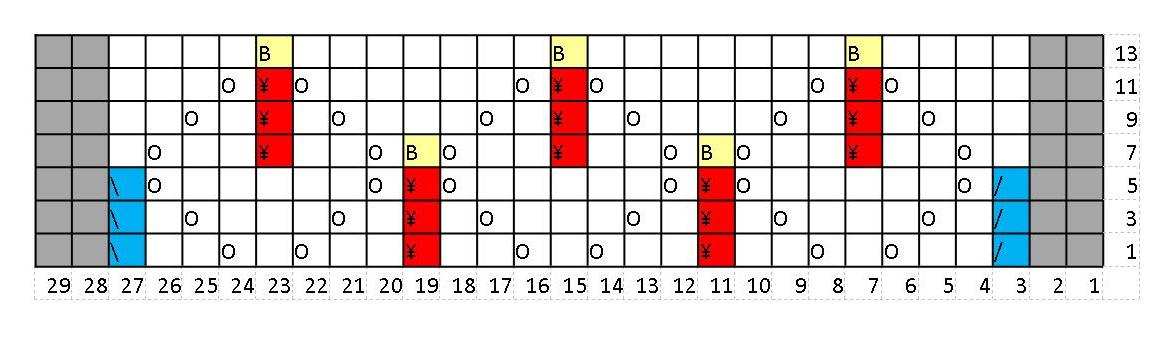
First, string on approximately 45 small glass beads onto your yarn.  Pull them down a few feet to give yourself plenty of slack. The beads will be accessible but you’ll constantly be pushing them down as you pull up more yarn from the rest of the skein.  Cast on 29 stitches, somewhat loosely, and knit two rows. Starting from the right of the pattern with row number 1, follow the pattern according to the chart. Pearl every other row, knitting the first two and last two stitches (in gray).

¥  S2KP: Slip 2 stitches together as if to knit, then knit 1, then pass both slipped stitches over together

\  K2TOG: Knit 2 stitches together (Left Decrease)

/  SSK: Slip the first stitch purlwise, knit the next stitch, pass the slipped stitch over (Right Decrease)

O  YO: Yarn over (adding a stitch)

Repeat six-row pattern about 20 times or until 100 oz are finished. Applying the beads:  The beads can be placed every 7th or 13th row as designated in the chart (B), so they will sitting above the ¥  S2KP from the previous row. Knit in the beads by bringing forward one of the strung-on beads and knitting it into the stitch so that it is seen from the knit side of the pattern. You may need to futz with it a little to get it to show through to the knit side.  Apply them randomly at one of the designated B spots every 13th or 19th row or so.

Finishing: Make your last row the end the pattern (i.e., the 11th row). Knit two rows and bind off loosely. Block. Do not iron.

Adapted from “Easy Leaves Scarf” pattern © 2010 by Jennifer L. Jones