• The knitting experience in culture, history, and daily life

The Knitted Word

The Knitted Word

Category Archives: Uncategorized

Knitting like it’s 1995

31 Thursday Mar 2016

Posted by theknittedword in Article review, Knitting History, Latvia, Russia, Uncategorized

≈ 1 Comment

Some time in 2014 I stopped knitting. It happened about the same time that I received a hand-me-down laptop and, soon after, in the evenings after the kids fell asleep, I began a habit of sitting by the fireplace (no longer by my cold office’s desktop computer) and getting lost in Internet surfing – that common, modern-day refrain.  I fell asleep many nights exhausted, a few hours past my ideal bedtime, my eyes still twitching and searching in the dark and quiet after the fire had simmered down to the embers and the screen had gone blank and the battery had died.

Thankfully, a few moments have since then saved me from a complete fall from knitting grace. Like this summer when I learned that my best friend was pregnant with her first and only baby. Nothing, not even the most thought-provoking political commentary circulating on Facebook, could stop me from making a baby sweater for her (knitting grace returns), albeit in a pattern that I had used a few times before (there’s the backsliding), and certainly not in time for the baby shower (some things will never change).  The baby sweater forced me to knit again, despite the pull of the Internet and its answers to life’s questions. The matching baby blanket is taking longer of course; the baby’s Kindergarten graduation might be a more realistic deadline for that.

When I think of my fall from prodigious, devoted knitter to inveterate web-surfer, I recall an essay by Rebecca Solnit. “In or around June 1995 human character changed again,” she writes in her August 2013 essay on modern-day life and the Internet in the London Review of Books, referring to the year that restrictions on commercial traffic on NSFNET – the backbone of the Internet – were loosened, and Amazon, Craigslist, and eBay began. After that, usage of the Internet grew and then ballooned, forever changing the way we live. Not without consequence, of course.  Solnit writes, “Nearly everyone I know feels that some quality of concentration they once possessed has been destroyed” since we began our devotion to the devices that now constantly prey on our time and attention.

Solnit’s writing is a salve for my Internet-drained spirit. I am not alone in this unhappy transition from committed knitter and creative designer to anxious,  interesting-article surfer.  Of the time before the Internet, she writes, “That bygone time had rhythm, and it had room for you to do one thing at a time…” The year she cites tugs at me: 1995. A watershed year for me personally, too: that fall in college I went to study in St. Petersburg, Russia, where I fell in love with the language, the Brothers Karamazov, European cosmopolitan living, and a fellow foreigner.  I had no Internet access in Russia, not even an e-mail address. To communicate with my family in Minnesota I yelled into a Soviet-era rotary dial phone in my host family’s apartment. Correspondence with my friends was hand-written on lined paper. That year, my parents wrote me, Minnesota had the coldest winter ever on record – colder even than in Siberia, my Siberian-born grammar teacher reported excitedly.

I regretfully returned home in the summer of 1996, leaving my foreign love and that happiest place behind. I cried the whole way home.  Back at school that fall, I eagerly logged onto the brand new Gopher protocol system to send e-mail messages to my sweetheart overseas.  I thought it would save us, this new-fangled, convenient, and immediate contact at our fingertips. And it did, at first, but soon e-mail became mundane: it was used for school work and quick messages to friends in town. So instead, we wrote letters. Long letters in messy writing and big cursive D’s for Dear and on all different types and sizes of paper – lined paper, scratch paper, napkins, etc. My letter writer had European handwriting which was cursive and sometimes different (like the crossed 7), and his English had mistakes. He would cross out wrong spellings of words or phrases (or the right spellings, too). His handwriting became messier as he forged on until, by the fourth or fifth page, the words stretched out and leaned heavily to the side, the ink of the blue pen faded and was replaced with black. Without even reading the words, you could see the evidence of time passing, of ink blotting and slurring, of a person yawning and getting tired, of a person living and breathing.

The letters were like life-saving medicine for our love, although for us it was more akin to the unnecessary-intervention kind of medical treatment, the kind that keeps you going much longer than you should. After I moved to Latvia for my Peace Corps service, our relationship had thinned out (though the letters continued) until finally he wrote to tell me that he had fallen in love with a Russian. To which my Latvian friends said without hesitation: “Vīriešiem un tramvajiem nav vērts skriet pakaļ, Sariņa, jo noteikti atnāks nākamais” (Nither men nor trams are worth chasing, dear Sarah; because with both you know for certain that another one will always come along). Little solace for my broken heart, but comforting to have had the support of sympathetic friends, at least. But those hand-written letters… what an artifact! What a different world from today: we might as well have been driving horse-drawn buggies! They seem old-fashioned today, but in 1995 they were the norm. Today, I struggle to remember how it felt to take the time to sit down and write a four-page letter on a legal pad, both sides, my hand cramping half-way through, all in the effort to maintain a relationship, no less. I only wish I could see what my own hand wrote, what was neatly folded up, stamped, and sent away. Alas, there is no fetching them from my sent folder.

Solnit writes in her article that now, post-2010, many people are trying to return to the pre-1995 era in an effort to regain our attention spans and strengthen our concentration again. She writes, “Some of the young have taken up gardening and knitting and a host of other things that involve working with their hands, making things from scratch, and often doing things the old way. It is a slow everything movement in need of a manifesto that would explain what vinyl records and homemade bread have in common. We won’t overthrow corporations by knitting – but understanding the pleasures of knitting or weeding or making pickles might articulate the value of that world outside electronic chatter and distraction, and inside a more stately sense of time.” Feeling a stately sense of time: this must be even more satisfying than surfing the web aimlessly next to the fireplace. It sounds like it is.

Of course, the notion of getting back to the pleasure of handmade and to a time long passed is not new to the knitting world. In the Winter ’99/’00 issue of Vogue Knitting, hand-knitting designer Norah Gaughan wrote her forecast for knitting in the next millennium (“2000…The Year 2 Knit!”):  “I see knitting becoming increasingly important as a tool for self enrichment…The feel of wonderful fiber in one’s hands, the meditative rhythm of the work, the challenge of new techniques and the pride of completion, will be motivations for the knitter of the 21st century…. Enlightened educators are finding that by knitting, students are quickly transported to a ready-to-learn state… Get them hooked now and knitting will be the thinking person’s craft of the new millennium.” Gaughan’s knitting experience meets Solnit’s written wisdom.

Ironically, it was also in 1995 – only five years earlier – that the same magazine was touting a different refrain. VK, Fall ’95, explained for the upcoming season that “stitches are less important than texture, color and shape… [and] since there is so little leisure time for making handcrafts, it’s necessary to have yarns that do more of the work for us” (my emphasis). The three-page section featured piles of beaded, glimmering, variegated yarns. “Man-made fibers like polyamide, polyester, acetate, viscose and metalloplastics are mixed or twisted with contrasting yarns for reflective flashes of light.”

Novelty surface effects more important than knitting technique? Yes, indeed, human character had changed. The Fall ’95 Vogue Knitting predictions may have properly highlighted the convenience of the new mixed media yarns, but hailing them as the medicine that could save knitting in the new age of busyness was misguided. They failed to acknowledge the needs that the new era would generate, like the need for something slow and handmade that takes lots of rich, grandiose time, something that makes us feel connected to the earth and to other real people.  Knitting something that takes a long time and cramps your hands half way through and can come only from you may just be the medicine that keeps us fulfilled, satisfied, and left not feeling empty and alone. The new manmade yarns mirror a high-tech, busy, distracted world, while the time-consuming projects that depend on good stitch definition and the naturally perfect stretch of wool help deflect all that our Internet-consumed modern world is throwing on us.  Knitting designer Debbie Bliss gets this: her 2013 book, “Knits For Your and Your Home,” is divided into blissed-out, anti-modern-technology chapters entitled “Indulge,” “Cocoon,” “Pamper,” and “Detox.” While some patterns require only one (beautiful, natural, high-quality) skein of yarn (like soft cashmere or lofty angora) and are incredibly quick to knit up, others are intentionally time-consuming, like the cable-knit chair back covers that mock all overflowing, attention-greedy email inboxes the world over.

I do feel a renewed desire to knit more now, though less for achieving a stately sense of time than for the sake and honor of all lost or dying hand-made arts (hand-written letters and complicated stitch patterns, both; I am a martyr to such causes). I have yet to post anything knitted here though. I am currently stuck on the second of a pair of socks for my mom, made from yarn so dark that I am defeated for months every time I lose some stitches on the size 1 DPNs. The baby blanket is now on the final row. All hope is not lost.

For the record, the man I eventually married, an American, is a good writer, though we’ve only known e-mail writing.  As nice as his e-mails are, I must admit that I don’t keep them in a special inbox folder, categorized the way my work messages are. But my husband’s hand-written cards? I definitely keep those.


On bacon fat and poetry

19 Wednesday Nov 2014

Posted by theknittedword in Uncategorized

≈ 3 Comments

When I first arrived in Aloja after three months of language training in a nearby city, I was hosted for a few days by a well known poet, writer, and translator named Daina Avotiņa at her home in the countryside. Staying with Daina was my first exposure to the real Latvia: we drank milk straight from the cow, ate homemade caraway cheese, and slept under coarse olive green and heather yellow woolen blankets inside her old, wooden cottage. I was almost completely unintelligible at that point. I remember trying my shallow conversational skills with her family at the rustic wooden dining table; my cheeks hurt from smiling so much. As a departing gift, Daina handed me a large hunk of bacon fat from one of her farm’s pigs. I probably looked like a deer caught in headlights when I received it; I didn’t have a clue what do with it. At least I knew the words to thank her for it.

I ended up eating most of that fat throughout the following winter.  Despite – or because of – my broken Latvian and general dumb innocence as a foreigner, my downstairs neighbor Nora took it upon herself to take care of me. Which meant, that she fed me.  If I could capture my whole two years of living in Aloja, in Latvia, of my life in the Peace Corps, it would be this: getting called downstairs for dinner by Nora (“Sariņ, nac est!”) to eat mashed potatoes a la bacon fat along with a glass of fresh milk and then watching, late into the night, re-runs of Beverly Hills 90210 dubbed in Latvian. (Nora claims that she never fell asleep watching 90210 even though she had been up since 4am to milk the cows; she says she was able to watch the shows “ar vienu aci cietu,” with one eye closed.) And as the steps between Nora’s and my door became worn and more familiar, the coarse Latvian woolen blankets became warm and inviting to me and dinner was no longer complete without bacon fat.

Daina’s name came back to me some time in my second year when Nora lent me her mother-in-law’s sewing machine. It was a hand-operated black Singer from the early 1900’s, decorated with gold filigree and still a solid and smooth machine. It had survived the March 1949 deportation to Siberia with Nora’s mother-in-law and her two small boys.  One day while I was rummaging around inside a drawer of the well traveled machine (I had been fixing up my finds from the Scandinavian Humanitarian Aid clothing pop-up store, which Nora mockingly called the “Humani” or “Humpali,”),  I found a folded up, aged yellow newspaper clipping alongside some fabric and thread scraps. On it was was a poem written by Daina called “Tu jau tālāk aizvedīsi,” or “You will continue to carry.” Here is my translation. (If you are a Latvian speaker, corrections are welcome!)

Par ŝo zaļo zemes malu,
Ko par Dzimteni es saucu,
Cilvēki ir atdevuŝi
Mūžus daudzus.
For this edge of green land,
That I call my Native Land,
People have given
Many lives.
Pūsdzīvotus. Nedzīvotus.
Neprasot, vai atlīdzinās.
Neprasot, vai viņu vārdi
Paliks talākceļu mina.
Half-lived. Not lived.
Not asking for anything in return.
Not asking if their name
Would be remembered down the road.
Protams, katram sava daļa.
Dzīves sauciens. Aicinājums.
Es jau arī nebūtību
Savā esamībā krāju.
Of course, everyone has their own part.
Life’s calling. An invitation.
I also count nothingness
In my own existence.
Bet par to, ka redzu sali,
Redzu zālē rases zibu,
Redzu bērna tīro smaidu –
Kādam paldies sacīt gribu.
But because I see the sun,
I see the glint of dew on the grass,
I see a child’s pure smile –
I want to thank someone.
Dzimtene, lai Tev tas paldies.
Kad par tavu zemi kļuŝu,
Tu jau tālāk aizvedīsi
Baltus manu bērnu mūžus.
Native Land, let you be the one thanked.
When I am a part of your earth,
You will continue to carry
The brightest of my children’s lives.

We figured the poem must have been written some time in the mid to late 1980’s when it was relatively safe to publish something nationalistic (referring to this “edge” of the Soviet Union, I would surmise). It had to have been Jacis, Nora’s mother-in-law who had been deported, who put the poem in the sewing machine.  I wish I knew which newspaper it was published in and when exactly it was published; did it not raise any red flags for its nationalist message? Was it a local paper that was able to avoid national attention? Or was the content considered subtle, as it doesn’t mention Latvia specifically?

To me, the poem is so very Latvian – a paean to land, to the soil. Eschewing the German Lutheran God that only tenuously erased the ancient Latvian pagan way of life, she thanks the land for her life.  Why is the land so important? In Latvia, it is what has given most of the Latvian people their surnames: Bērziņŝ, Ozols, Kalniņš, Liepiņš, Avotiņa – birch, oak, hill, linden tree, a spring. It is what has given the natural dyes and the wool to the classical woolen blankets; it has provided the bacon fat that gives flavor to Latvians’ rustic, traditional foods; it has given the reeds that shape Latvians’ straw table coverings and wall hangings; it has provided the flowers that are given at every celebration.  This is a country where I was publicly laughed at – where I almost lost my credibility as a human being! – when I casually referred to a pine tree (“priede”) as a fir tree (“egle”). Trees are things you do not confuse in a country that highly esteems its nature and soil. No, these natural things from the land are a part of life.

This poem and translation are posted in honor of November 18th, Latvia’s Independence Day, celebrating independence from the Russian Empire in 1918. Sveiks lai dzivo!

First Quilt

13 Monday Oct 2014

Posted by theknittedword in Uncategorized

≈ 2 Comments

P1060444

My 2nd-grade daughter is learning about America’s Pioneers this fall at school. Soon the kids will take a field trip to a one-room school house, for which they get to dress up in pioneer clothes if they like. Their study culminates in the presentation of a pioneer-based project that they’ve done at home.

I know a bit about these kinds of school projects from my daughter’s study on the raccoon last year.  The teacher asks that the children do the projects on their own, but really, where is the line between guiding a frustrated child and just assembling the raccoon artwork into the mobile yourself? This year’s project on Pioneers has seemed no different. From a long list of the teacher’s suggestions, my daughter chose to make a covered wagon out of paper. I found several plans for cardboard-based pioneer wagons that exacted directions offering little room for originality; the whole plan indeed was darkened by a vision of myself gluing together the wagon while my daughter looked on, bored and impatient or just coloring the wheels with crayons. Fortunately for all of us, my in-laws came for a weekend to visit and my mother-in-law rescued the Pioneer project with a little quilting work.

While my mother-in-law was raising her family she was an avid quilter. She has given us a handful of quilts (some of which she made herself, others of which were made by family members).  For my daughter’s Pioneer project, my mother-in-law drafted a simple nine-patch quilt square pattern. All day long the two of them traced squares, measured, pressed, and cut fabric, and sewed on the machine to piece the square together. I couldn’t have been happier with my daughter so involved in her school project, besides so thoroughly enjoying the close company of her grandma. Every so often I stepped in to preach about the relevance of Pioneer-like thriftiness in using leftover scraps of fabric and how quilts were needed to cushion the hard, uncomfortable seats of the covered wagons and to keep safe during dust storms, among other things. The busy quilters mostly ignored me, the constant din of my informative chatter floating above the hum of the sewing machine. By the end of the day, grandma and granddaughter had almost finished their imperfect, colorful handmade square, lastly bordered with “Prairie Points” like in the Prairie Queen quilt, one of the many beautifully named patterns that were popular during pioneer days.

Tracing, cutting, sewing on the machine, pressing – it all came naturally to my daughter, who insisted on doing more sewing the second day.  It couldn’t have happened without the gentle guidance of my knowledgable and skilled mother-in-law. While my daughter was sewing at the machine she looked content, carefully finishing each piece and moving the needle up out of the way before she lifted the foot and removed the fabric to cut the thread. She was focused, deliberate, calm. For a girl whose favorite color is “all the colors of the rainbow, even black,” this patchwork sewing gig is right up her alley. She is a bit doomed to it, I suppose: her dad’s side of the family awash with quilters and her mother obsessed with saving and writing about the beauty and meaning in hand-made things.

Which brings me back to the preaching: I want so much for my daughter to learn about the importance that quilting and handcrafts have played in women’s lives in history.  While she and my mother-in-law were working, I briefly looked up “quilting in Pioneer America” and found a rich history. One site, “Patterns from History,” wrote that “Pioneer quilting had come full circle from making quilts in anticipation of the journey to the opportunity to express creativity through quilting in the new land.” (The history on pioneer quilting has been fleshed out pretty well in several books and websites devoted to quilting history and I now have a couple of titles waiting in my library request queue!) Before we started the project, as I worked on convincing my daughter to try out the patchwork quilt instead of making the cardboard wagon, I heard myself repeating the things I believe about why people continue to hand-knit: that it’s not just to make clothing or blankets because we need them to survive, but we make them carefully by hand to have something beautiful and meaningful for our everyday lives.  Machine-made items can be beautiful and wonderful and much, much easier and cheaper than hand-made items, but so many machine-made things are also quickly and poorly made and just as quickly disposed of. I know because I frequent all of the used-clothing stores in town and they are often full of junky, machine-made clothing and housewares. What a dangerous cycle for ourselves and our planet! Just because we CAN produce tons of clothes for cheap things doesn’t mean that we should. Oh, it all drives me crazy, this kind of waste.

I also can’t help but wonder what my daughter’s take from all of the sewing and talk of handcrafts is, besides being a wonderful bonding time with her grandma and getting her school project done. Does she think that sewing is women’s work, or that sewing is just another medium for an artist?  Like my own mother wanted for me, I want my daughter to not be restrained by the old, sexist constraints and stereotypes as she plots out her life.  I want her to travel and see the world and to pursue whatever work or goals she needs, regardless of whether it is a male-dominated profession, regardless of whether our culture or individual people tell her it is appropriate for a woman.  My daughter’s goal in life right now, though, is to become an artist – it has been for over a year – and her favorite art projects are often crafts. She is a little confused by what it means to be an artist, too, and last night inquired at bedtime about how much money artists make.  Trying to keep awake as we lay there in the dark, with the big pink ceramic shell nightlight (that my grandma made) on in the corner of her room, the barley bag warming our feet under my mom’s homemade down comforter, I murmured the line, “Find what you love to do, honey, and the money will come.” But she didn’t go for it. She said worriedly (and with new non-sleepy vigor) that she had heard from other people that artists don’t make money and she wants to make lots of money to buy things like lego sets and iPads. Our conversation drifted slightly into the meaning of life and the role of money before trailing off into sleepy silence.

P1060446

Oh, how my heart aches for her – she’s only seven years old!  For my budding artist, here’s to more creative, thrifty, even feminist quilts. May she and all of our family – and yours – be always blanketed with warmth, beauty, and meaning.


Between Two Suns

05 Friday Sep 2014

Posted by theknittedword in Uncategorized

≈ 2 Comments

I got shivers yesterday when I heard President Obama promise that NATO would defend the Baltic States no matter what.  Mostly, because it’s politically hard to justify such a promise, at least to those with isolationist tendencies (e.g., libertarians, CATO Institute).  Each of these three countries has a small population (Estonia at 1.3 million, Latvia at 2 million, and Lithuania at about 3 million; for reference, the population of Chicago is about 2.7 million). The countries have little strategic benefit to the U.S. with no real resources to mention (if you don’t count amber, sprats, and Skype; though Riga is a major transportation hub and port). Yet, the three little countries are independent democracies and NATO allies and were supporters of the coalition forces in Iraq, and as such they have sent and lost troops to Iraq and Afghanistan along side American and other countries’ troops. And, they are at the European doorstep to Russia.

This geographic and political situation of the Baltic countries brings to mind a catchy song by the Latvian rock band Prāta Vētra (Brainstorm), called “Starp Divām Saulēm,” (translated officially as “Among The Suns” but a more literal translation would be “Between Two Suns”). The suns to me being the many foreign powers that have driven Latvia’s fate for the last several centuries: Germans from the 13th century on, Swedes for a period, and Soviets or Russians and Europe and the West in the 20th century.   The band, lead by Renārs Kaupers, is beloved in Latvia.  The song came out while I lived in Latvia 1998-2000 and was incredibly popular. 

Lai no kādām tālēm nācis, Liekas tikko elpot sācis
Starp divām saulēm izvēlēties – Spožāko un neapdedzināties
Virs mums ir divas, divas debesis
Pa vienām ienākt, otrām atdoties,
Vienām tuvoties, no otrām – izvairīties
Virs mums ir divas, divas debesis
Un vēl virs mums ir divas zvaigznes
Zem vienas dzīvot, pēc otras ilgoties
Ja pirmā kritīs, tu priecāsies,
Bet varbūt liktenis atspēlēsies,
Virs mums ir divas zvaigznes
Lai no kādām tālēm nācis, Liekas tikko elpot sācis
Starp divām saulēm izvēlēties – Vēsāko un atveldzēties
Lai no kādām tālēm nācis, Liekas tikko elpot sācis
Starp divām saulēm izvēlēties – Mīļāko un iemīlēties

From whatever distant places you’ve come, it seems you just started breathing
Choose between the two suns – the brightest one, and don’t get burnt
There are two skies above us
Come through one, surrender to the other
Approach one, avoid the other
There are two skies above us
There are also two stars
Live under one, long for the other
If the first one falls, you celebrate
But maybe fate will retaliate
There are two stars above us
From whatever distant places you’ve come, it seems you just started breathing
Choose between the two suns – the coolest one and get refreshed
From whatever distant places you’ve come, it seems you just started breathing
Choose between the two suns – the loveliest, and fall in love

*I looked at a Russian translation of the song (“Между двух солнц”) to check my work, and “lai” was translated as “неважно,” which led me to use “whatever.” Otherwise “lai” could be “be it” or “let” or “in order to” or “so that,” etc.

The first line is haunting: it makes me think of Latvia’s brief taste of independence between the two world wars, after Latvians had gained independence from the Russian Empire on November 18th, 1918.  Democracy and the economy struggled but grew, while land, for centuries owned by the minority Baltic German landowners who were the governing elite, was given to the Latvian peasants to farm. The country lasted like this for barely a couple of decades before being consumed and corrupted by the anxiety preceding World War Two and the world economic crisis.  In August of 1939 the Russian-German Molotov-Ribbentrop Pact relegated the Baltic states to the Soviet sphere. By June 1940, Soviet troops occupied the country; within a month, fraudulent elections declaring new Communist leadership led to the country’s assimilation into the Soviet Union as a republic.  By the end of 1941, the Soviets had deported, mostly to Siberia, 35,000 Latvians (including minority citizens such as Jews, Germans, Russians) who were accused of being Anti-Soviet.  But there was more: By July 1941, Nazi Germans occupied Riga; then, the killing of Jews started – 85,000 in Latvia by the end of the war. The Soviet Union won back the country in the fall of 1944. 

Despite the violence, by the end of the song Kaupers calls for choosing the loveliest, the sweetest sun and falling in love with it (iemīlēties; no subtle dipthongs here, but instead: ee-ye-mee-lay-tee-yes, he croons again and again).  And who knows? Maybe the song doesn’t have to be so literally about politics and being bandied back and forth between two heavyweight neighbors;  maybe it’s about the beauty found in choosing between two divergent paths.  A bit of Frost’s road less traveled by, perhaps, minus the nostalgia and confidence. 

*****

I’m guilty of believing that the Soviet Occupation, as awful as it was – deporting and imprisoning and killing so many, trying to wipe out a people’s language and culture and self-expression and voice, destroying an economy and democracy – is also responsible for helping preserve one of the Baltic States’ greatest treasures: their skilled, creative, expressive, artistic knitting.  Today, people still knit, but there isn’t the absolute necessity.  I really, really don’t want to romanticize this, and I see that I am on the verge of it here; instead, I mean to point out that knitting was a source of national and personal expression by thousands of Balts, which, in turn, I believe helped them hold onto a bit of their national identity during the Soviet Occupation. Knitting mittens and hats and sock in their town’s particular style or colors or designs was a small, somewhat safe way of expressing self and nationality in an oppressive police state.  (I say “somewhat safe” because of a story from one of my former school students in Latvia: her father’s mother had knit two hats in the colors of the Latvian flag for her two sons; it was only a matter of time before the one brother called from the police station, caught for expressing nationalism, to warn his little brother not to wear the other hat.) 

Not only could knitting be an expression of nationalism, but a personal expression too, an expression of beauty and creativity and vanity and self. The communist, authoritarian state did not promote these values. It was hard to find a really beautifully made sweater in the Soviet Union. If you did, after waiting in a long line to purchase it you would probably end up finding it being worn by someone else with better connections. Instead, many people in the Baltic states used skills they had learned over the past centuries from the Baltic German landowners, and they knit for themselves. Keep in mind, these are countries that are obsessed with flowers and beauty: at almost every celebration people give flowers, and during the Soviet Union it was the Baltic republics that supplied Moscow and St. Petersburg with flowers, not the more southern republics with warmer climates.  

Meanwhile, during this same period in the 1950’s-1990’s in Capitalist Western European countries, knitting became a hobby, a fringe of society in consumerist economies that easily provided affordable, beautiful sweaters.  I don’t want to disparage knitting as a hobby either. I am a hobby knitter myself and I love how knitting has become more popular in the last decade or so.  The patterns I see in Interweave and Vogue Knitting and Ravelry are inspiring and energizing. Knitting for yourself and your family is not a necessity though, and don’t they say that necessity is the mother of invention? When I lived in Latvia about ten years after it regained independence, I was overwhelmed by the expression and abundance of hand-knitted things among my friends and even my youngest students. I can still see one of my 4th graders, Kristina, swiftly knitting up elaborate pieces in between lessons. Granted, I also remember hearing friends squawk when they’d rather be doing something else. Here, I’m thinking of my wonderful friend and neighbor Nora who supposedly begrudgingly knitted and darned socks for her husband Morris.  And in some cases, I had to agree: I’d rather be outside picking plums or black currants with Nora on a beautiful Latvian summer day and drinking sour birch juice, or watching re-runs of our favorite episodes of Beverly Hills 90210, or drinking strong coffee and Finnish chocolate together.  Of course, we did plenty of that too.  Enough to gear us up for more knitting, I suppose. 


Hyvää päivää!

19 Thursday Sep 2013

Posted by theknittedword in Uncategorized

≈ 4 Comments

That’s “Good day!” in Finnish. Growing up in my small hometown in northern Minnesota, Finnish influence was a quiet but certain presence in our lives: our neighbors took saunas, in school we celebrated St. Urho for driving the grasshoppers out of Finland, we told Finnish jokes, and our Finnish-heritage teachers made us learn how to spell their sharp, rolling long last names (can you spell Koskiniemi?). Even though it was a small town in the woods – population 2,976 when I graduated high school, and a two-hour drive from the closest city, Fargo-Moorehead – it fortunately happened to be home to a sweet little Finnish imports store, “Irene’s Favorite Things,” which was and still is housed in the back of Harvala’s Appliances (“The Wild Finlander!”, Irene’s husband).

My mother often admired and sometimes collected the store’s Iittala glass and ceramics, all clean lines and radiance and modernity from the famous Finnish company. Iittala made modern, glass tableware, bold and unusual creations from the 1970’s and earlier. Their designs were a far cry from the folksy, romantic floral Scandinavian design that my mom grew up with on the farm. They were also a refreshing contrast with American country designs.  When I went into Irene’s Favorite Things this summer, though, I saw a new look to the Ittala designs that seemed to bring all of those different styles together. Naturally, they used knitting to do it!  This is not the edgy, modern Iittala glassware that I remember from the 80’s and 90’s. This is still elegant but it is more folksy, and a nod to the traditional and the hand-made.

photo-5Looking at their whole line of designs you can see their inspiration in folklore and nature. This knit-themed series, called Sarjaton, according to the Iittala website, is “Shaped by tradition, tailored for today.” The red clay cup is called “Letti,” or braid, and the other cup is “Tikki,” or stitch.  The other design in this series is called “Metsä,” or woods. I like what one of the design teams said about these choices: “We collected rustic material and for half a year we examined textiles and abstracts.” (All of you knitting & textile enthusiasts, wouldn’t you love to do that for your job?) “Metsä” is particularly interesting to me: at first I thought it looked like stitches, but when I saw the translation of the name, I could see the pine trees instead (click on the Sarjaton link and you can see this design). The knit stitches mimic the pine trees.

The Iittala designers write further:  “Embossed patterns based on traditional basket braids, embroidery motifs and the forest that covers half of Finland, deliver a handcrafted feeling that invites you to touch. While modern life has made us crave for an authentic feeling, the Sarjaton collection takes us back to the way things were made before. The real way.” (My emphasis.) Is this not a craving we have when we knit? To know and feel how something real is made by your own two hands. Not only that, though, this series accepts and honors the home-made effect. Even the images on the “Tikki” cup, pictured in red clay, above, show the slight imperfections in hand-knitting, the rows being slightly uneven and inconsistent.

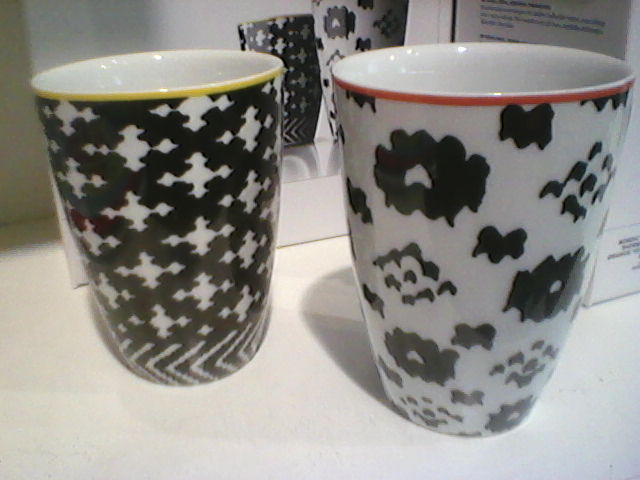
Well, it wasn’t only in my hometown’s lovely Finnish imports store where I saw knitting in porcelain. On my way  through Minneapolis, I found these cups in the American Swedish Institute gift store:

Amer Swedish Inst pictures -1

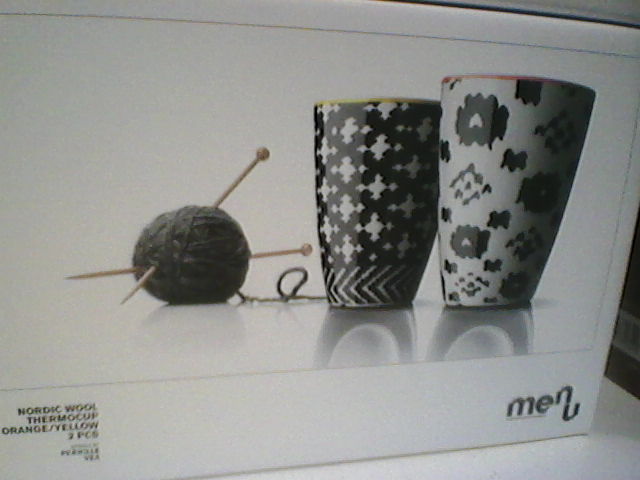
These cups are made by Menu, a Danish company that sells on Amazon, Walmart, etc.. They’ve latched on to the knitting trend too, though not in such a rustic way. The Menu company writes: “Nordic Wool is a thermo cup inspired by the highly fashionable patterns known from Nordic knits. The knit sweaters were hot in the 70s but are again must-haves from several fashion houses this season, and now for the first time the knit patterns make their entrance on cool thermo cups.”

Amer Swedish Inst pictures -2

Either way, whether you choose home-made authenticity or fashion spin-offs, to knit by the fire with a knitted cup beside you (especially one with lovely stitch definition) would be the ultimate in getting into the knitting mood.  A knitted cozy for the cup would certainly be appropriate; possibly a knitted coaster as well? Inspiration certainly abounds.

The life and death of an heirloom

25 Friday Jan 2013

Posted by theknittedword in American history, Art, Craft magazines, Knitting History, Uncategorized, Women's history

≈ 1 Comment

I’ve been looking through some American craft magazines from the 1940’s, 50’s and 60’s and marveling at the changes in our culture since they were published: there are numerous patterns for lace doilies and lace edging for women’s handkerchiefs, advertisements for wonderful new types of synthetic yarn, and articles about how to make money by recycling tin cans into plates or selling mail-order greeting cards. It makes me wonder, what happened to all of the things that the readers – like my grandmothers and great grandmothers – might have made from these magazines?

I suppose they could have ended up in Mike Kelley’s 1987 piece, “More Love Hours Than Can Ever Be Repaid,” which I saw in the 2011 Walker Art Center exhibit The Spectacular of the Vernacular. I went there to see two beautiful sculptures by my brother, Aaron. The exhibit “considers how artists have claimed homemade handicrafts or rustic aesthetic traditions in new ways.” (PBS.org) Kelley did that with his huge tapestry of old, discarded hand-made dolls, stuffed animals and afghans.

To me, his piece was looking at and questioning the value and necessity of homemade things in our culture. As a life-long knitter, I took it personally. The bears and afghans were familiar and reminded me of the crocheted and knitted things my grandma, neighbors, and other family friends made for me and my brothers in the 1970’s and 1980’s. More importantly, only a few weeks before seeing the Walker exhibit I myself had given a hand-knitted bunny to my four-year-old daughter for Christmas.

IMG_2782

While my daughter liked receiving it – she proudly remembered me working on it – I noticed several days later that she hadn’t played with it yet, even though the wool was locally spun (Bemidji Woolen Mills); the dress was made from luxurious, somewhat expensive alpaca yarn; and I had spent hours making a swatch, planning out the yarn, and knitting and piecing it together (I hate piecing). It had been a labor of love for my child. But despite my best efforts, the bunny didn’t really turn out to be as “good” as store-bought: it wasn’t as soft and cuddly as her plush bears, it had no buttons or batteries. So when I saw Mike Kelley’s piece, I wondered: will my daughter’s little bunny end up discarded like these other imperfect, scratchy homemade bears and blankets? What becomes of the imperfect, useless, scratchy, acrylic or wool hand-made things when there are perfect, shiny machine-made products that often become more loved, more used, more necessary to our daily lives? Is there a general lack of quality craftsmanship that is missing in our craft culture in America, where just the fact that something is handmade and not made at a factory makes an item not only a novelty but an heirloom as well?

These questions, I suppose, compel me to try to make things better. That is, if I can make something that is really beautiful, really special and fits just perfectly, it will be as good as factory-made and store-bought and will be loved and used – and keep it from ending up in the dustbin. Ultimately, though, I’m going to say that it doesn’t really matter what happens with my knitting after I’ve finished it and given it away. I love the knitting process and the moment of giving something I’ve made, and of course I would like to know the person appreciated it and could use it. But after I’ve given it away, it is no longer for me to decide. And I am only as good as my latest work, right? So I will keep trying to make better bunnies and socks and scarves…

And as for my own family’s many “heirloom” sweaters, afghans and doilies, I am happy to say that, after a few button and stitch repairs and despite the fact that they are acrylic (I prefer wool) my husband’s grandma’s sweaters keep us beautiful and warm all winter and my grandma’s afghans keep my daughter cozy at night. The dozens of my grandma’s colorful and intricate hand-crocheted doilies, however, remain piled up in the drawer of my china cabinet. At least they have each other’s company: the bunny remains on my daughter’s dresser, well dressed, but alone.

Enter your email address to follow this blog and receive notifications of new posts by email.

Archives

  • March 2016
  • November 2014
  • October 2014
  • September 2014
  • September 2013
  • July 2013
  • June 2013
  • April 2013
  • March 2013
  • February 2013
  • January 2013
  • December 2012
  • November 2012
  • October 2012
  • September 2012
  • August 2012

Topics

  • American history
  • Art
  • Article review
  • Book review
  • Craft magazines
  • DPN's
  • Family history
  • Felt
  • Flax
  • Indiana
  • Industrial Revolution
  • Knitting History
  • Latvia
  • Minnesota
  • New York City
  • Pattern
  • Pottery
  • Recipe
  • Russia
  • Scandinavia
  • Sheep
  • Socks
  • Spinning
  • Translations
  • Uncategorized
  • Weaving
  • Women's history

Blogs I follow

  • carolynmaurice
  • mauricesgarden
  • Norway. Meaning?
  • Max Schireson's blog
  • Weaving Gifts Together
  • domaphile
  • ClothRoads
  • Gather
  • wool&gathering
  • JjD
  • Antris Blog
  • PRACTICE SPACE
  • KDD & Co
  • The Domestic Soundscape
  • sourtoothjournal.blogspot.com
  • The Knitted Word

Some interesting websites

  • ClothRoads “Our Mission: Creating opportunities for supporting indigenous textile artisans worldwide.”
  • Thrums: A world of textiles in books and other media
  • Bloc Socks: “Tell Your Feet the Cold War is Over”
  • Musturs: Adītāju klubiņš / Knitters club
  • Unbored: The Essential Field Guide to Serious Fun
  • Meisterdarbs: A knitting website, this page lists the most interesting Latvian hand-craft blogs

Interesting books

Meta

  • Create account
  • Log in
  • Entries feed
  • Comments feed
  • WordPress.com

Create a free website or blog at WordPress.com.

carolynmaurice

This WordPress.com site is our trip to SE Asia/November 2012

mauricesgarden

Norway. Meaning?

Max Schireson's blog

Thoughts on technology and the tech business

Weaving Gifts Together

domaphile

ClothRoads

Gather

:handmade shoppe & Co:

wool&gathering

Knitting, design, wool and other gatherings....

JjD

Antris Blog

Rokdarbi

PRACTICE SPACE

KDD & Co

Award-winning Scottish publishing and design

The Domestic Soundscape

making, listening, thinking

The Knitted Word

Privacy & Cookies: This site uses cookies. By continuing to use this website, you agree to their use.
To find out more, including how to control cookies, see here: Cookie Policy
  • Subscribe Subscribed
    • The Knitted Word
    • Already have a WordPress.com account? Log in now.
    • The Knitted Word
    • Subscribe Subscribed
    • Sign up
    • Log in
    • Report this content
    • View site in Reader
    • Manage subscriptions
    • Collapse this bar
 

Loading Comments...