• The knitting experience in culture, history, and daily life

The Knitted Word

The Knitted Word

Category Archives: Scandinavia

Vær så god!

31 Monday Dec 2012

Posted by theknittedword in DPN's, Family history, Minnesota, Pattern, Scandinavia, Socks

≈ Leave a comment

My double-themed Christmas knitting fervor this year is almost complete: I sent off my niece’s white knit-in-the-round-with-DPNs hat (picture in the last post); the reversible double-knit potholder for my sister-in-law is pretty, but too small and better suited as a washcloth; the knit-in-the-round socks are beautiful but also too small for my mom, so that the lovely patterned reinforced heel slides onto the foot more than it should.  Now they will go to my sister-in-law for her January birthday and I will make another pair for my mom – then, finally, the knitting double marathon will be over, for the time being.

IMG_4958

Pattern: TPHPE by Heather Zoppetti, free on Ravelry

IMG_4953

Pattern: Toe-up Socks by Leah Mitchell from “More Last-minute Knitted Gifts” by Joelle Hoverson

I can’t help but knit something special for my mom for Christmas. It is for her the most important event of the whole year. It is a time that brings us all back to her childhood, growing up on a dairy farm in a town of Norwegian immigrants where her mother always made the traditional Norwegian dinner at Christmas, and which we continue to make every year: lutefisk, lefse, Swedish meatballs; rømmegrøt (a cream porridge) and yifta.  Beautiful sugar cookies – krumkake, sandbakels, fattigman, rosettes, and drømmer cookies – were made by my grandma, my great aunt Imogene, and other relatives, neighbors, or members of the Norwegian Lutheran church where my grandma played organ for more than forty years.  At the dinner table on Christmas eve, after church, my grandma and grandpa passed the food with a “vær så god”: here you go, your welcome. Tusen takk, is the reply. After dinner we sang with my mom’s sisters Silent Night, Oh Come All Ye Faithful, and Jeg er så glad hver julekveld (I am so happy on Christmas eve) around the piano, all of the songs that my mom now puts on repeat on her radio for most of December and probably January too.
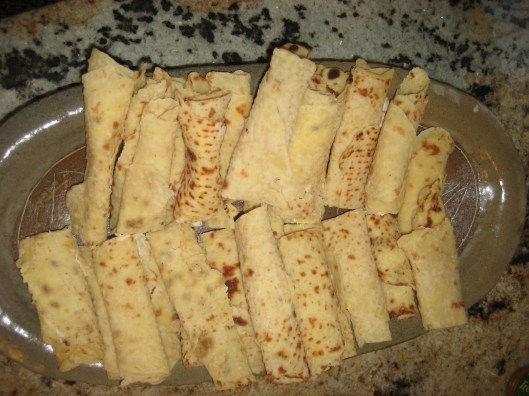
IMG_3953

Lefse: like a tortilla made with potato and flour, buttered and rolled up
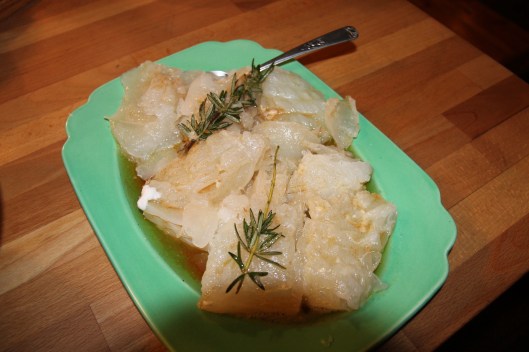
IMG_3534

Lutefisk: cod soaked in lye, boiled several hours to remove the lye, and served with melted butter

IMG_3951

Yifta: cranberry sauce, whipped cream, graham cracker crumbs

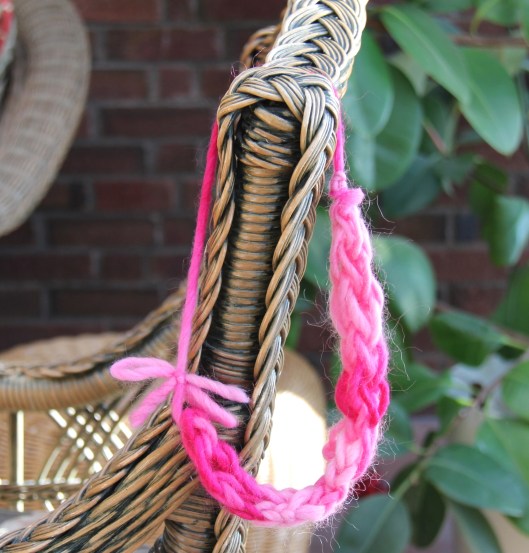
With such rich traditions and meaning I can’t give my mom something simple. And so I knit for her, though not always perfectly. Happily, my daughter saved my too-small-sock  gift by giving my mom the best knitted surprise of all: a pink wool necklace which she knitted on her little, five-year-old fingers. Vær så god, mom!
IMG_3620

Exclusive hand-knit sweater!

26 Wednesday Sep 2012

Posted by theknittedword in Book review, Scandinavia

≈ 1 Comment

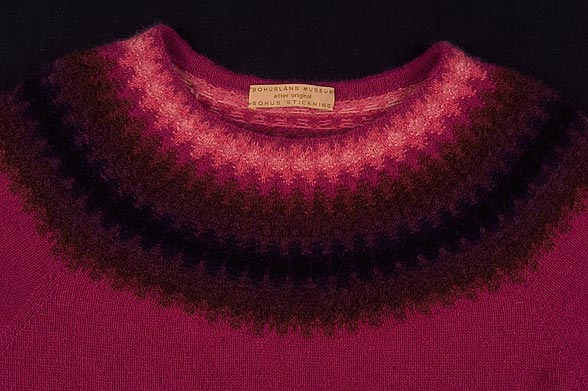
“The Red Palm” Design: Kerstin Olsson, 1967; picture posted with permission from Bohusläns Museum

Last week I opened up the most recent Garnet Hill catalogue and saw a gorgeous bobbles & lace knit sweater next to this caption: “E/Hand-Knit Sweater EXCLUSIVE Lusciously soft Italian blend of acrylic/wool/viscose/alpaca… Italy/Imported….#27525 $88.” It makes me want to know – just who is hand-knitting these sweaters for such a low price? Or is that just the name of the “style” of this sweater… After I count up the hours it takes me to actually knit something – I’m a moderately fast knitter when I get going – plus the time in designing or just making a gauge, plus the cost of the yarn: it is priceless!  (Something I usually only start to realize when buying insurance for my precious hand-knitted items to be sent in the mail.)

The subject of hand-knitting for sale brought to mind the knitting book I most recently finished: Wendy Keele’s history of “Bohus Stickning,” a Swedish knitting business that created so many beautiful and unique hand-made sweaters from the 40’s through the 60’s.  The business was started for women in rural, southern Sweden (Bohuslän) who were struggling to make ends meet following the depression. In 1937 the women approached Emma Jacobsson, the wife of the governor of Bohus, to look for a cottage industry for the women to make money while taking care of their children, homes and farms. Emma settled upon knitting, something that the women in this region could already do and that required few tools. She found innovative designers and encouraged them to create new, interesting, and fashionable sweaters, hats, and mittens that were eventually marketed around the world, most importantly to wealthy foreigners. She demanded the highest quality of wool, paying higher than usual prices to the best wool producers, and she demanded perfection in the actual knitting and sizing. Bohus Stickning grew and thrived as the economy improved in the 1950’s, but by the early 60’s demand fell and in April 1969 Bohus ceased operations.  So much had changed in that period of time as cheaper, machine-made sweaters became much more easily available and fashions and styles had evolved.

While reading I was struck by the story of the women who actually did the knitting.  After Bohus closed, some of the knitters wrote letters of gratitude for Bohus and all that it gave them. One wrote, “It will be a big loss not to get Bohus knitting anymore. It had been so interesting and nice when sitting alone…” (Keele, page 51). This lovely glimpse into domestic life of the past is something that I think about often as I raise my two children and struggle to meet that happy point between taking care of them and meeting my own professional, personal, financial, etc. needs.  I wonder how my ancestors – several of them from nearby Norway – managed to cook and preserve and farm while raising children who constantly get into things and need so much. On top of all of that, the Bohus women were knitting perfect sweaters for others to make a little extra money; they were docked pay when the sizing was off or there was a mistake in the pattern, Keele writes. When I read political histories about important actors and decisions, I miss this part of the story – the day-to-day life of people in a particular time and place, especially of the people taking care of hearth and home.

The larger history during this time and place is striking too: Bohus Stickning was founded in September 1939, the year that Germany invaded Poland and effectively started World War II in Europe.  If Sweden would have taken sides in World War II – the country was neutral – the knitted goods made by Bohus Stickning most likely would have supported the war effort. Of course Bohus was not unaffected by the war, Keele explains; at one point the Swedish government required a permit for wool to be exported and spun in Finland where Emma sent some of her finest wool; later, the Finnish government banned all wool exports. Still, I can’t help but think of the home knitters in New Zealand during World War II who supported their troops by knitting them thousands of socks made from their country’s wonderful wool of course. (I read about this in Heather Nicholson’s book, The Loving Stitch: A history of knitting and spinning in New Zealand, published by Auckland University Press, 1998.) How differently Bohus Stickning might have developed – how different those women’s lives would have been! – had Sweden changed political course.

From Garnett Hill, to Sweden, to domestic life, to politics, and now to New Zealand. It looks like I’ve chosen my next book to read!

Photo used with permission from Interweave Press. Photo by Joe Coca, © 1995 Interweave Press and Joe Coca, http://www.interweavestore.com/store/Search.aspx?SearchTerms=Keele

“Poems of color: knitting in the Bohus tradition,” Interweave Press, 1995; by Wendy Keele  http://www.interweavestore.com/Knitting/Books/Poems-Of-Color.html

Enter your email address to follow this blog and receive notifications of new posts by email.

Archives

  • March 2016
  • November 2014
  • October 2014
  • September 2014
  • September 2013
  • July 2013
  • June 2013
  • April 2013
  • March 2013
  • February 2013
  • January 2013
  • December 2012
  • November 2012
  • October 2012
  • September 2012
  • August 2012

Topics

  • American history
  • Art
  • Article review
  • Book review
  • Craft magazines
  • DPN's
  • Family history
  • Felt
  • Flax
  • Indiana
  • Industrial Revolution
  • Knitting History
  • Latvia
  • Minnesota
  • New York City
  • Pattern
  • Pottery
  • Recipe
  • Russia
  • Scandinavia
  • Sheep
  • Socks
  • Spinning
  • Translations
  • Uncategorized
  • Weaving
  • Women's history

Blogs I follow

  • carolynmaurice
  • mauricesgarden
  • Norway. Meaning?
  • Max Schireson's blog
  • Weaving Gifts Together
  • domaphile
  • ClothRoads
  • Gather
  • wool&gathering
  • JjD
  • Antris Blog
  • PRACTICE SPACE
  • KDD & Co
  • The Domestic Soundscape
  • sourtoothjournal.blogspot.com
  • The Knitted Word

Some interesting websites

  • ClothRoads “Our Mission: Creating opportunities for supporting indigenous textile artisans worldwide.”
  • Thrums: A world of textiles in books and other media
  • Bloc Socks: “Tell Your Feet the Cold War is Over”
  • Musturs: Adītāju klubiņš / Knitters club
  • Unbored: The Essential Field Guide to Serious Fun
  • Meisterdarbs: A knitting website, this page lists the most interesting Latvian hand-craft blogs

Interesting books

Meta

  • Create account
  • Log in
  • Entries feed
  • Comments feed
  • WordPress.com

Create a free website or blog at WordPress.com.

carolynmaurice

This WordPress.com site is our trip to SE Asia/November 2012

mauricesgarden

Norway. Meaning?

Max Schireson's blog

Thoughts on technology and the tech business

Weaving Gifts Together

domaphile

ClothRoads

Gather

:handmade shoppe & Co:

wool&gathering

Knitting, design, wool and other gatherings....

JjD

Antris Blog

Rokdarbi

PRACTICE SPACE

KDD & Co

Award-winning Scottish publishing and design

The Domestic Soundscape

making, listening, thinking

The Knitted Word

Privacy & Cookies: This site uses cookies. By continuing to use this website, you agree to their use.
To find out more, including how to control cookies, see here: Cookie Policy
  • Subscribe Subscribed
    • The Knitted Word
    • Already have a WordPress.com account? Log in now.
    • The Knitted Word
    • Subscribe Subscribed
    • Sign up
    • Log in
    • Report this content
    • View site in Reader
    • Manage subscriptions
    • Collapse this bar
 

Loading Comments...