Some time in 2014 I stopped knitting. It happened about the same time that I received a hand-me-down laptop and, soon after, in the evenings after the kids fell asleep, I began a habit of sitting by the fireplace (no longer by my cold office’s desktop computer) and getting lost in Internet surfing – that common, modern-day refrain. I fell asleep many nights exhausted, a few hours past my ideal bedtime, my eyes still twitching and searching in the dark and quiet after the fire had simmered down to the embers and the screen had gone blank and the battery had died.
Thankfully, a few moments have since then saved me from a complete fall from knitting grace. Like this summer when I learned that my best friend was pregnant with her first and only baby. Nothing, not even the most thought-provoking political commentary circulating on Facebook, could stop me from making a baby sweater for her (knitting grace returns), albeit in a pattern that I had used a few times before (there’s the backsliding), and certainly not in time for the baby shower (some things will never change). The baby sweater forced me to knit again, despite the pull of the Internet and its answers to life’s questions. The matching baby blanket is taking longer of course; the baby’s Kindergarten graduation might be a more realistic deadline for that.
When I think of my fall from prodigious, devoted knitter to inveterate web-surfer, I recall an essay by Rebecca Solnit. “In or around June 1995 human character changed again,” she writes in her August 2013 essay on modern-day life and the Internet in the London Review of Books, referring to the year that restrictions on commercial traffic on NSFNET – the backbone of the Internet – were loosened, and Amazon, Craigslist, and eBay began. After that, usage of the Internet grew and then ballooned, forever changing the way we live. Not without consequence, of course. Solnit writes, “Nearly everyone I know feels that some quality of concentration they once possessed has been destroyed” since we began our devotion to the devices that now constantly prey on our time and attention.
Solnit’s writing is a salve for my Internet-drained spirit. I am not alone in this unhappy transition from committed knitter and creative designer to anxious, interesting-article surfer. Of the time before the Internet, she writes, “That bygone time had rhythm, and it had room for you to do one thing at a time…” The year she cites tugs at me: 1995. A watershed year for me personally, too: that fall in college I went to study in St. Petersburg, Russia, where I fell in love with the language, the Brothers Karamazov, European cosmopolitan living, and a fellow foreigner. I had no Internet access in Russia, not even an e-mail address. To communicate with my family in Minnesota I yelled into a Soviet-era rotary dial phone in my host family’s apartment. Correspondence with my friends was hand-written on lined paper. That year, my parents wrote me, Minnesota had the coldest winter ever on record – colder even than in Siberia, my Siberian-born grammar teacher reported excitedly.
I regretfully returned home in the summer of 1996, leaving my foreign love and that happiest place behind. I cried the whole way home. Back at school that fall, I eagerly logged onto the brand new Gopher protocol system to send e-mail messages to my sweetheart overseas. I thought it would save us, this new-fangled, convenient, and immediate contact at our fingertips. And it did, at first, but soon e-mail became mundane: it was used for school work and quick messages to friends in town. So instead, we wrote letters. Long letters in messy writing and big cursive D’s for Dear and on all different types and sizes of paper – lined paper, scratch paper, napkins, etc. My letter writer had European handwriting which was cursive and sometimes different (like the crossed 7), and his English had mistakes. He would cross out wrong spellings of words or phrases (or the right spellings, too). His handwriting became messier as he forged on until, by the fourth or fifth page, the words stretched out and leaned heavily to the side, the ink of the blue pen faded and was replaced with black. Without even reading the words, you could see the evidence of time passing, of ink blotting and slurring, of a person yawning and getting tired, of a person living and breathing.
The letters were like life-saving medicine for our love, although for us it was more akin to the unnecessary-intervention kind of medical treatment, the kind that keeps you going much longer than you should. After I moved to Latvia for my Peace Corps service, our relationship had thinned out (though the letters continued) until finally he wrote to tell me that he had fallen in love with a Russian. To which my Latvian friends said without hesitation: “Vīriešiem un tramvajiem nav vērts skriet pakaļ, Sariņa, jo noteikti atnāks nākamais” (Nither men nor trams are worth chasing, dear Sarah; because with both you know for certain that another one will always come along). Little solace for my broken heart, but comforting to have had the support of sympathetic friends, at least. But those hand-written letters… what an artifact! What a different world from today: we might as well have been driving horse-drawn buggies! They seem old-fashioned today, but in 1995 they were the norm. Today, I struggle to remember how it felt to take the time to sit down and write a four-page letter on a legal pad, both sides, my hand cramping half-way through, all in the effort to maintain a relationship, no less. I only wish I could see what my own hand wrote, what was neatly folded up, stamped, and sent away. Alas, there is no fetching them from my sent folder.
Solnit writes in her article that now, post-2010, many people are trying to return to the pre-1995 era in an effort to regain our attention spans and strengthen our concentration again. She writes, “Some of the young have taken up gardening and knitting and a host of other things that involve working with their hands, making things from scratch, and often doing things the old way. It is a slow everything movement in need of a manifesto that would explain what vinyl records and homemade bread have in common. We won’t overthrow corporations by knitting – but understanding the pleasures of knitting or weeding or making pickles might articulate the value of that world outside electronic chatter and distraction, and inside a more stately sense of time.” Feeling a stately sense of time: this must be even more satisfying than surfing the web aimlessly next to the fireplace. It sounds like it is.
Of course, the notion of getting back to the pleasure of handmade and to a time long passed is not new to the knitting world. In the Winter ’99/’00 issue of Vogue Knitting, hand-knitting designer Norah Gaughan wrote her forecast for knitting in the next millennium (“2000…The Year 2 Knit!”): “I see knitting becoming increasingly important as a tool for self enrichment…The feel of wonderful fiber in one’s hands, the meditative rhythm of the work, the challenge of new techniques and the pride of completion, will be motivations for the knitter of the 21st century…. Enlightened educators are finding that by knitting, students are quickly transported to a ready-to-learn state… Get them hooked now and knitting will be the thinking person’s craft of the new millennium.” Gaughan’s knitting experience meets Solnit’s written wisdom.
Ironically, it was also in 1995 – only five years earlier – that the same magazine was touting a different refrain. VK, Fall ’95, explained for the upcoming season that “stitches are less important than texture, color and shape… [and] since there is so little leisure time for making handcrafts, it’s necessary to have yarns that do more of the work for us” (my emphasis). The three-page section featured piles of beaded, glimmering, variegated yarns. “Man-made fibers like polyamide, polyester, acetate, viscose and metalloplastics are mixed or twisted with contrasting yarns for reflective flashes of light.”
Novelty surface effects more important than knitting technique? Yes, indeed, human character had changed. The Fall ’95 Vogue Knitting predictions may have properly highlighted the convenience of the new mixed media yarns, but hailing them as the medicine that could save knitting in the new age of busyness was misguided. They failed to acknowledge the needs that the new era would generate, like the need for something slow and handmade that takes lots of rich, grandiose time, something that makes us feel connected to the earth and to other real people. Knitting something that takes a long time and cramps your hands half way through and can come only from you may just be the medicine that keeps us fulfilled, satisfied, and left not feeling empty and alone. The new manmade yarns mirror a high-tech, busy, distracted world, while the time-consuming projects that depend on good stitch definition and the naturally perfect stretch of wool help deflect all that our Internet-consumed modern world is throwing on us. Knitting designer Debbie Bliss gets this: her 2013 book, “Knits For Your and Your Home,” is divided into blissed-out, anti-modern-technology chapters entitled “Indulge,” “Cocoon,” “Pamper,” and “Detox.” While some patterns require only one (beautiful, natural, high-quality) skein of yarn (like soft cashmere or lofty angora) and are incredibly quick to knit up, others are intentionally time-consuming, like the cable-knit chair back covers that mock all overflowing, attention-greedy email inboxes the world over.
I do feel a renewed desire to knit more now, though less for achieving a stately sense of time than for the sake and honor of all lost or dying hand-made arts (hand-written letters and complicated stitch patterns, both; I am a martyr to such causes). I have yet to post anything knitted here though. I am currently stuck on the second of a pair of socks for my mom, made from yarn so dark that I am defeated for months every time I lose some stitches on the size 1 DPNs. The baby blanket is now on the final row. All hope is not lost.
For the record, the man I eventually married, an American, is a good writer, though we’ve only known e-mail writing. As nice as his e-mails are, I must admit that I don’t keep them in a special inbox folder, categorized the way my work messages are. But my husband’s hand-written cards? I definitely keep those.


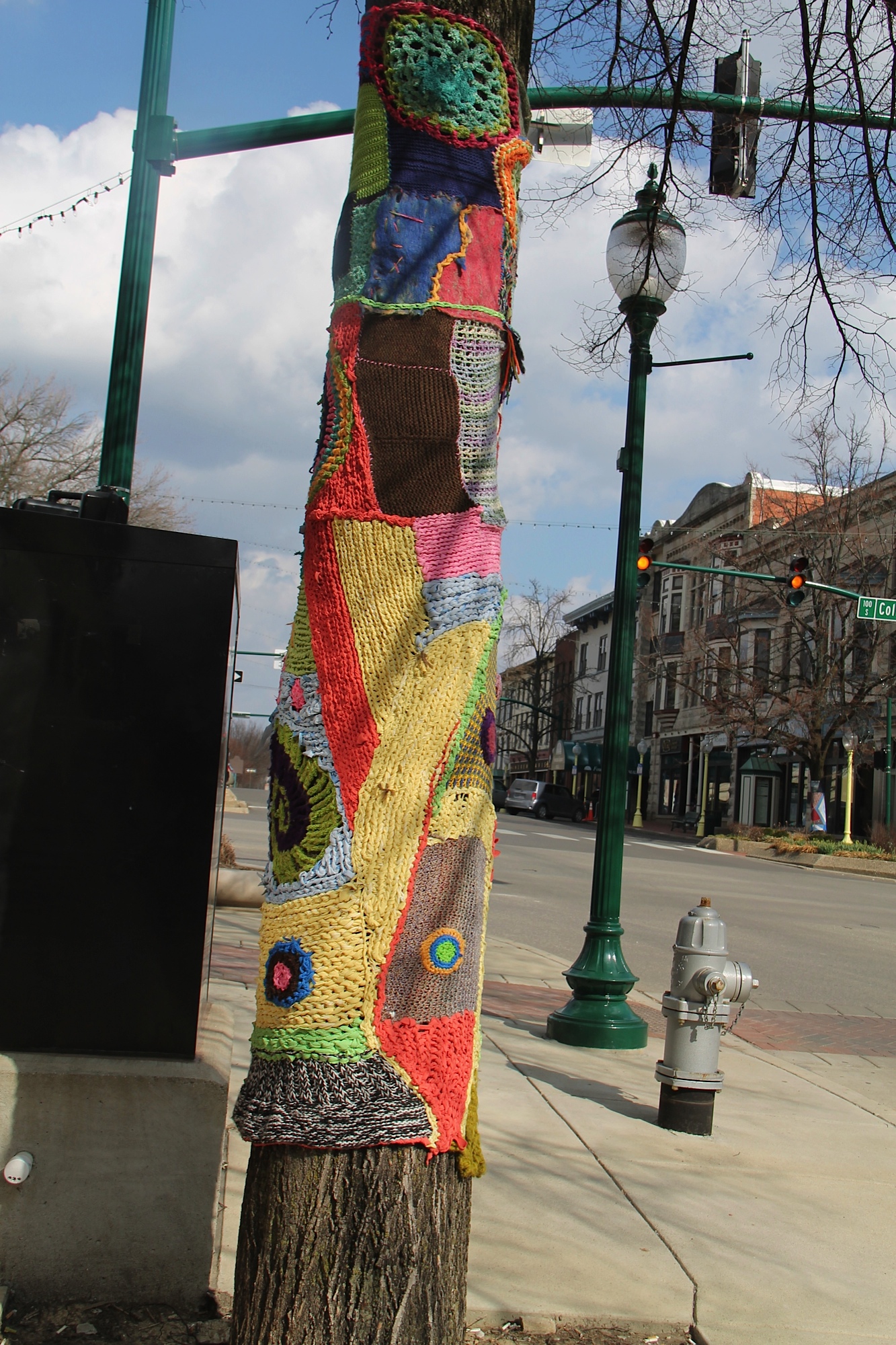

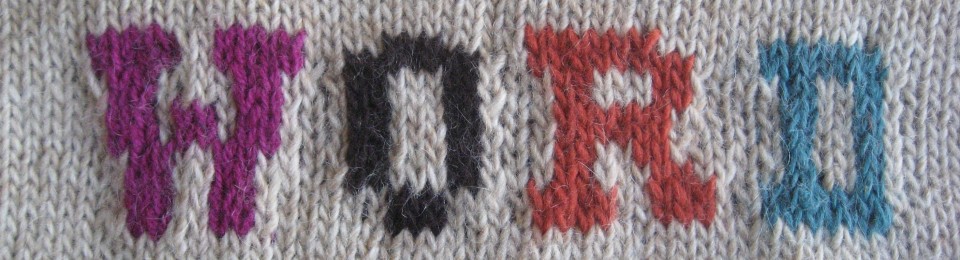
 The Knitted Word