
Exploring at great grandma’s farm.
It is hard not to find myself exploring at my grandma’s large, old farm house in southern Minnesota, a place that once housed my grandparents, their five children, their in-laws, and a great aunt. It is a house that has names for the rooms: the girls’ room, Olga’s room, the Mystery room, great grandma and grandpa’s room. Even when full of guests for the holidays I can easily find myself alone in a room full of my family‘s history in books, sheet music, clothes, toys, and blankets. My grandma loves history too, and going through closets she often finds old family treasures, like long-lost letters and pictures she had almost forgotten about.
On my last visit, knowing my interest in knitting my grandma showed me a small collection of pocket-sized craft magazines from the 1950’s and 60’s which her mother-in-law had subscribed to, called The Workbasket. She let me take some home, and I realize now that I assumed they would not really be of much value to my knitting except as a token of history. My assumption has partly proven true: so many things are just not my style or are totally unnecessary in the 21st century. There are patterns for crocheted doilies to protect the back and arms of your couch or to protect your tables, for hand-made lace to edge your pillows, for hand-crocheting bands to hold together your linens nicely, for tatting the edges of your handkerchiefs. The February 1956 issue has one pattern for handkerchief edging that “will really be a conversation piece if worked in two colors” (vol. 21, no. 5, page 30). Ah, now if only I had a handkerchief… Some of the advice is silly, today: “Saran Wrap,” they write, “the clear plastic film, is a wonderful help in storing sweaters, afghans, stoles and other woolens.” And when your knees need a break from gardening? Sew your old shoulder pads into the knees of your gardening slacks! Imagine Martha Stewart telling readers to do that, or to add rotted manure or dried cow manure to houseplants to help them grow better. Or to sell greeting cards to friends and neighbors to make money for yourself or as a fundraiser for your church: in the January 1956 issue (vol. 21, no. 4) I found no fewer than eleven large ads for how readers can do this and “make $50 to $250 or more in your spare time – without any experience!”

The local General Store, closed for a few years now but still stocked with cards.
Handkerchiefs, shoulder pads, slacks, ads for inexpensive accordions and Orlon, an acrylic/polyester/vinyl yarn that is now discontinued, black-and-white photos, the tiny print, the rough, yellowed paper – the magazine is definitely dated. But it’s not useless, not at all. There are so many gems I found in these journals, like the adorable crocheted belt in the June 1955 issue and the round knit rug, pattern below, which I am adding to my knitting to-do wish-list. I am always keeping an eye out for pretty knitted summer sweaters and I happily found one with raglan sleeves and a buttoned placket in the August 1965 issue. Of course, I have to watch out for the details in these older patterns. Often the exact type of yarn is not given (the January 1956 cover sweater pattern gives only, “a deluxe sock and sport yarn was used to make this model”), and the sizing is something to watch out for too: a small is bustline 32; large is bustline 36. Otherwise, there are just different types of patterns to be found in this magazine. Today in knitting magazines I see patterns for hats, socks, scarves and sweaters; in these magazines from 1955, 1956, and 1965 I see place mats, rugs and sweaters. I was surprised to see that so many patterns required size 10 needles. I had assumed that this larger needle was a contemporary phenomenon.
The Workbasket started in 1935 and ceased publication in 1996, and during that time fashion and technology evolved dramatically; the change is clear even in the brief span of issues that I have, 1955-1965. In the 1955 and 1956 issues, the only color is on the cover in the template background; by my August 1965 issue, models are posing in their hand-knit sweaters in full color on the cover and sometimes inside. I still found doilies and one recipe asking for graham flour (a rarity in grocery stores today) in the 1965 issues, but gone are the card-selling advertisements and the money-making opportunities for stay-at-home women. Instead of the delicate doily place mats in the earlier issues, I found a beautifully knit place mat in April 1966 (vol. 31, no. 7, page 11) that is pretty and practical and could easily be found in a contemporary knitting journal. On a side note, I thought it was interesting to see that pink was definitely being marketed for girls in one 1966 issue: a pink-knit dress for an infant is called a “lovely little dress for some precious princess,” (More on the transition from blue to requisite pink for baby girls in the United States at: http://www.pinkisforboys.org.)
With recipe, home, garden sections and fun, quirky ways to repurpose older things, The Workbasket is, I suppose, one of the predecessors to Country Living and Martha Stewart (though in today’s magazines the ideas are less quirky and more snarky, which is getting boring to me). Exploiting and promoting the importance of home in our lives and culture, these journals are a source of ideas for women who want to beautify and update their homes and lives and families with creativity and individuality and thrift and the latest fashions. One commentator on one of the many websites devoted to The Workbasket thought that this type of journal in the 1950’s was a sign to women to stay at home and “stay in their place.” That’s tough for me to agree with. I love these types of magazines and see so much creativity and ingenuity in them, though even more so in The Workbasket than in today’s more sleek, polished, and generic magazines. I can’t help but think that this journal for that period in time was providing a space and platform for women to explore their creativity while raising kids and taking care of hearth and home, whether they wanted to or had to or felt compelled to. Based on the great number of money-making schemes in these journals, I can see that this was a magazine for women anxious to earn money; based on the great variety of ideas for how to reuse and create things, I can see that the readers were anxious to be creative, inventive, useful, and efficient.
Thinking of these magazines in history, I am reminded of how women were negotiating the new roles they found themselves in by the middle of the 20th century – new roles, yes, because the decades that their mothers and grandmothers were raising kids were so completely different from this. Who else did they have to learn from? The women in the 1930’s and 1940’s could not look back at how their mothers raised them in the 1910’s and 1920’s to figure out how to navigate this new era of canned soup and pudding mix and Orlon and higher expectations for hosting and cleanliness. (Can you tell I’ve been influenced by Ruth Schwartz Cowan? She wrote “More Work For Mother: The Ironies Of Household Technology From The Open Hearth To The Microwave” and talks at length about how expectations have been growing for the average women in the home, even as there is less help to do it.) And so while I have scoffed at the elaborate doilies and hand-croched bands to wrap one’s neatly folded linens, I also love the relatively easy way that women could bring in little touches of sophistication, of refinement, to their newly modernized homes while managing food and home and children and working, teaching piano, doing farm chores, or raising money for school. Even my history-loving grandma, who is 92 and a devoted musician in love with her piano, has delighted me by giving us all hand-embroidered towels as gifts. Where does she find the time, I wonder?
By the way, I’m not the only one not untouched by my grandmother’s craftiness: while reading a feature about a textile artist in the February 2013 Martha Stewart, the featured artist was asked for the inspiration behind her witty, whimsical, artful creations. Her answer? “My grandmothers tatted or made their own dolls or nutty puppets,” she said. Exactly.
Round Knit Rug, from the June 1955 issue, Vol. 20, no. 9, page 14-15: Rug yarn and number 10 wooden knitting needles were used in making this simple wedge pattern. The completed rug may have 11 or 12 wedges in all. It may be made any size and may be made oval if desired by knitting full length rows for sides. Abbreviations: K (knit); p (purl); sts (stitches); rnd (round). Cast on 48 sts (or any multiple of 3 depending on size desired).
Rnd 1: K 6, p 3, turn.
Rnd 2: K 9.
Rnd 3: K 6, p 6, turn.
Rnd 4: K 12
Rnd 5: K 6, p 9, turn.
Rnd 6: K 15.
Rnd 7: K 6, p 12, turn.
Rnd 8: K 18.
Rnd 9: K 6, p 15, turn.
Rnd 10: K 21.
Rnd 11: K 6, p 18, turn.
Rnd 12: K 24.
Rnd 13: K 6, p 21, turn.
Rnd 14: K 27.
Rnd 15: K 6, p 24, turn.
Rnd 16: K 30.
Rnd 17: K 6, p 27, turn.
Rnd 18: K 33.
Rnd 19: K 6, p 30, turn.
Rnd 20: K 36.
Rnd 21: K 6, p 33, turn.
Rnd 22: K 39.
Rnd 23: K 6, p 36, turn.
Rnd 24: K 42.
Rnd 25: K 6, p 39, turn.
Rnd 26: K 45.
Rnd 27: K 6, p 42, turn.
Rnd 28: K 48.
Rnd 29: Work same as rnd 1. This begins the second wedge.
Make 11 or 12 wedges in all. Sew last row to the first row. Bind off on a knit round.
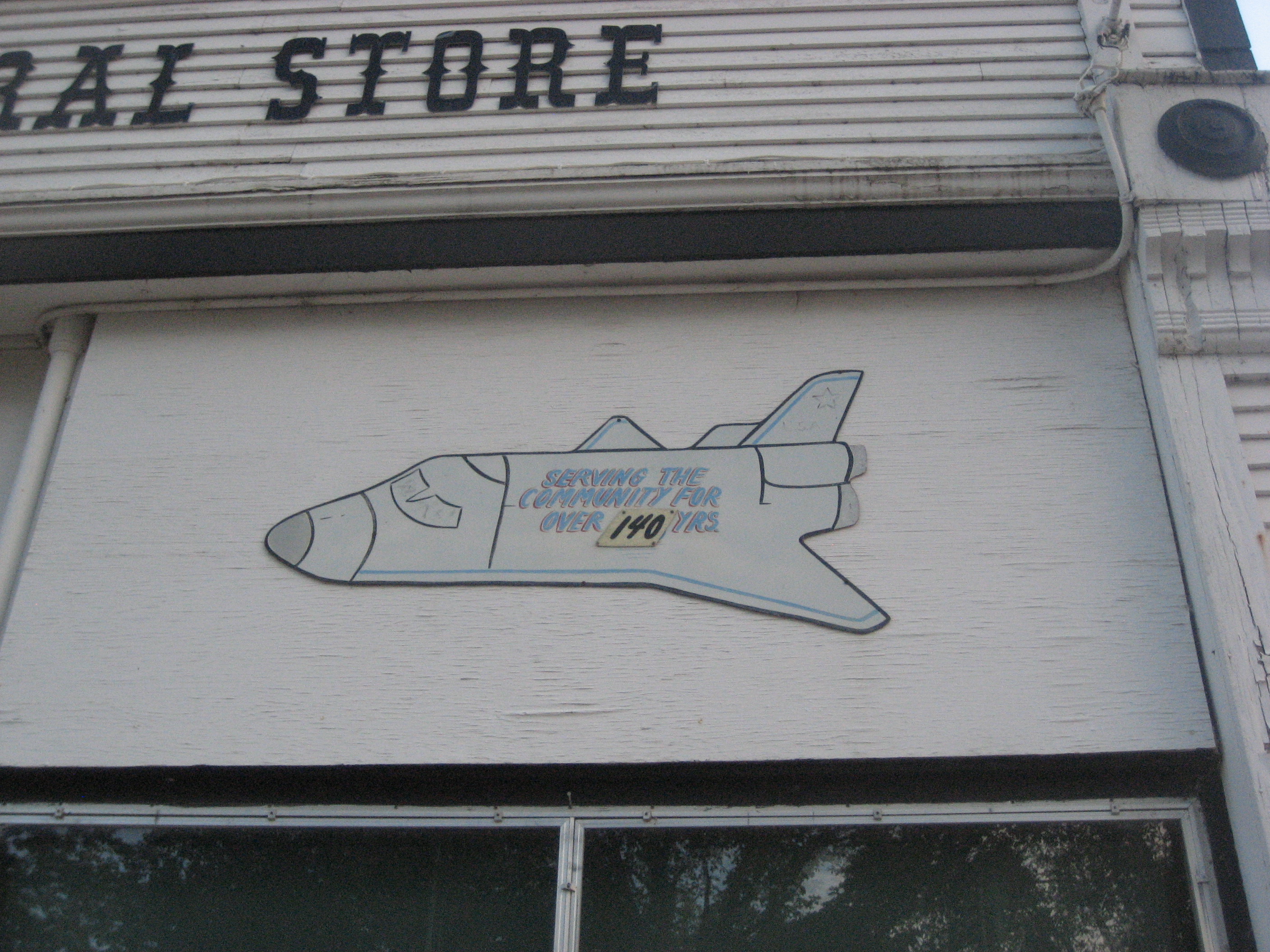
My grandma’s local general store, which closed down after 140 years.
Apricot Corn Flake French toast, my foodie sister-in-law has informed me, is still a very cool, very contemporary thing to make today. From the September 1966 issue, no. 12, vol. 31, page 30: “You’ll have many calls for seconds for this Apricot Corn Flake Toast” — 2 eggs, ½ cup apricot nextar; ¼ tsp salt, 8 slices day old bread, 3 cups corn flakes presweetened and crushed to make 1 ½ cups, 2-3 T butter or margarine: Combine eggs, apricot nectar and salt; beat. Dip bread slices in egg mixture, then cover both sides with cereal crumbs. Pan fry in butter or margarine until lightly browned and crisp on both sides, turning once. Serve hot with syrup, jelly or confectioners’ sugar. Yields 4 servings.

My daughter taking pictures at great grandma’s farm.




 The Knitted Word