• The knitting experience in culture, history, and daily life

The Knitted Word

The Knitted Word

Category Archives: Knitting History

Knitting like it’s 1995

31 Thursday Mar 2016

Posted by theknittedword in Article review, Knitting History, Latvia, Russia, Uncategorized

≈ 1 Comment

Some time in 2014 I stopped knitting. It happened about the same time that I received a hand-me-down laptop and, soon after, in the evenings after the kids fell asleep, I began a habit of sitting by the fireplace (no longer by my cold office’s desktop computer) and getting lost in Internet surfing – that common, modern-day refrain.  I fell asleep many nights exhausted, a few hours past my ideal bedtime, my eyes still twitching and searching in the dark and quiet after the fire had simmered down to the embers and the screen had gone blank and the battery had died.

Thankfully, a few moments have since then saved me from a complete fall from knitting grace. Like this summer when I learned that my best friend was pregnant with her first and only baby. Nothing, not even the most thought-provoking political commentary circulating on Facebook, could stop me from making a baby sweater for her (knitting grace returns), albeit in a pattern that I had used a few times before (there’s the backsliding), and certainly not in time for the baby shower (some things will never change).  The baby sweater forced me to knit again, despite the pull of the Internet and its answers to life’s questions. The matching baby blanket is taking longer of course; the baby’s Kindergarten graduation might be a more realistic deadline for that.

When I think of my fall from prodigious, devoted knitter to inveterate web-surfer, I recall an essay by Rebecca Solnit. “In or around June 1995 human character changed again,” she writes in her August 2013 essay on modern-day life and the Internet in the London Review of Books, referring to the year that restrictions on commercial traffic on NSFNET – the backbone of the Internet – were loosened, and Amazon, Craigslist, and eBay began. After that, usage of the Internet grew and then ballooned, forever changing the way we live. Not without consequence, of course.  Solnit writes, “Nearly everyone I know feels that some quality of concentration they once possessed has been destroyed” since we began our devotion to the devices that now constantly prey on our time and attention.

Solnit’s writing is a salve for my Internet-drained spirit. I am not alone in this unhappy transition from committed knitter and creative designer to anxious,  interesting-article surfer.  Of the time before the Internet, she writes, “That bygone time had rhythm, and it had room for you to do one thing at a time…” The year she cites tugs at me: 1995. A watershed year for me personally, too: that fall in college I went to study in St. Petersburg, Russia, where I fell in love with the language, the Brothers Karamazov, European cosmopolitan living, and a fellow foreigner.  I had no Internet access in Russia, not even an e-mail address. To communicate with my family in Minnesota I yelled into a Soviet-era rotary dial phone in my host family’s apartment. Correspondence with my friends was hand-written on lined paper. That year, my parents wrote me, Minnesota had the coldest winter ever on record – colder even than in Siberia, my Siberian-born grammar teacher reported excitedly.

I regretfully returned home in the summer of 1996, leaving my foreign love and that happiest place behind. I cried the whole way home.  Back at school that fall, I eagerly logged onto the brand new Gopher protocol system to send e-mail messages to my sweetheart overseas.  I thought it would save us, this new-fangled, convenient, and immediate contact at our fingertips. And it did, at first, but soon e-mail became mundane: it was used for school work and quick messages to friends in town. So instead, we wrote letters. Long letters in messy writing and big cursive D’s for Dear and on all different types and sizes of paper – lined paper, scratch paper, napkins, etc. My letter writer had European handwriting which was cursive and sometimes different (like the crossed 7), and his English had mistakes. He would cross out wrong spellings of words or phrases (or the right spellings, too). His handwriting became messier as he forged on until, by the fourth or fifth page, the words stretched out and leaned heavily to the side, the ink of the blue pen faded and was replaced with black. Without even reading the words, you could see the evidence of time passing, of ink blotting and slurring, of a person yawning and getting tired, of a person living and breathing.

The letters were like life-saving medicine for our love, although for us it was more akin to the unnecessary-intervention kind of medical treatment, the kind that keeps you going much longer than you should. After I moved to Latvia for my Peace Corps service, our relationship had thinned out (though the letters continued) until finally he wrote to tell me that he had fallen in love with a Russian. To which my Latvian friends said without hesitation: “Vīriešiem un tramvajiem nav vērts skriet pakaļ, Sariņa, jo noteikti atnāks nākamais” (Nither men nor trams are worth chasing, dear Sarah; because with both you know for certain that another one will always come along). Little solace for my broken heart, but comforting to have had the support of sympathetic friends, at least. But those hand-written letters… what an artifact! What a different world from today: we might as well have been driving horse-drawn buggies! They seem old-fashioned today, but in 1995 they were the norm. Today, I struggle to remember how it felt to take the time to sit down and write a four-page letter on a legal pad, both sides, my hand cramping half-way through, all in the effort to maintain a relationship, no less. I only wish I could see what my own hand wrote, what was neatly folded up, stamped, and sent away. Alas, there is no fetching them from my sent folder.

Solnit writes in her article that now, post-2010, many people are trying to return to the pre-1995 era in an effort to regain our attention spans and strengthen our concentration again. She writes, “Some of the young have taken up gardening and knitting and a host of other things that involve working with their hands, making things from scratch, and often doing things the old way. It is a slow everything movement in need of a manifesto that would explain what vinyl records and homemade bread have in common. We won’t overthrow corporations by knitting – but understanding the pleasures of knitting or weeding or making pickles might articulate the value of that world outside electronic chatter and distraction, and inside a more stately sense of time.” Feeling a stately sense of time: this must be even more satisfying than surfing the web aimlessly next to the fireplace. It sounds like it is.

Of course, the notion of getting back to the pleasure of handmade and to a time long passed is not new to the knitting world. In the Winter ’99/’00 issue of Vogue Knitting, hand-knitting designer Norah Gaughan wrote her forecast for knitting in the next millennium (“2000…The Year 2 Knit!”):  “I see knitting becoming increasingly important as a tool for self enrichment…The feel of wonderful fiber in one’s hands, the meditative rhythm of the work, the challenge of new techniques and the pride of completion, will be motivations for the knitter of the 21st century…. Enlightened educators are finding that by knitting, students are quickly transported to a ready-to-learn state… Get them hooked now and knitting will be the thinking person’s craft of the new millennium.” Gaughan’s knitting experience meets Solnit’s written wisdom.

Ironically, it was also in 1995 – only five years earlier – that the same magazine was touting a different refrain. VK, Fall ’95, explained for the upcoming season that “stitches are less important than texture, color and shape… [and] since there is so little leisure time for making handcrafts, it’s necessary to have yarns that do more of the work for us” (my emphasis). The three-page section featured piles of beaded, glimmering, variegated yarns. “Man-made fibers like polyamide, polyester, acetate, viscose and metalloplastics are mixed or twisted with contrasting yarns for reflective flashes of light.”

Novelty surface effects more important than knitting technique? Yes, indeed, human character had changed. The Fall ’95 Vogue Knitting predictions may have properly highlighted the convenience of the new mixed media yarns, but hailing them as the medicine that could save knitting in the new age of busyness was misguided. They failed to acknowledge the needs that the new era would generate, like the need for something slow and handmade that takes lots of rich, grandiose time, something that makes us feel connected to the earth and to other real people.  Knitting something that takes a long time and cramps your hands half way through and can come only from you may just be the medicine that keeps us fulfilled, satisfied, and left not feeling empty and alone. The new manmade yarns mirror a high-tech, busy, distracted world, while the time-consuming projects that depend on good stitch definition and the naturally perfect stretch of wool help deflect all that our Internet-consumed modern world is throwing on us.  Knitting designer Debbie Bliss gets this: her 2013 book, “Knits For Your and Your Home,” is divided into blissed-out, anti-modern-technology chapters entitled “Indulge,” “Cocoon,” “Pamper,” and “Detox.” While some patterns require only one (beautiful, natural, high-quality) skein of yarn (like soft cashmere or lofty angora) and are incredibly quick to knit up, others are intentionally time-consuming, like the cable-knit chair back covers that mock all overflowing, attention-greedy email inboxes the world over.

I do feel a renewed desire to knit more now, though less for achieving a stately sense of time than for the sake and honor of all lost or dying hand-made arts (hand-written letters and complicated stitch patterns, both; I am a martyr to such causes). I have yet to post anything knitted here though. I am currently stuck on the second of a pair of socks for my mom, made from yarn so dark that I am defeated for months every time I lose some stitches on the size 1 DPNs. The baby blanket is now on the final row. All hope is not lost.

For the record, the man I eventually married, an American, is a good writer, though we’ve only known e-mail writing.  As nice as his e-mails are, I must admit that I don’t keep them in a special inbox folder, categorized the way my work messages are. But my husband’s hand-written cards? I definitely keep those.


Finding a gem at grandma’s house

17 Sunday Mar 2013

Posted by theknittedword in American history, Book review, Craft magazines, Knitting History, Minnesota, Pattern, Recipe, Women's history

≈ 1 Comment

IMG_4577

Exploring at great grandma’s farm.

It is hard not to find myself exploring at my grandma’s large, old farm house in southern Minnesota, a place that once housed my grandparents, their five children, their in-laws, and a great aunt. It is a house that has names for the rooms: the girls’ room, Olga’s room, the Mystery room, great grandma and grandpa’s room. Even when full of guests for the holidays I can easily find myself alone in a room full of my family‘s history in books, sheet music, clothes, toys, and blankets.  My grandma loves history too, and going through closets she often finds old family treasures, like long-lost letters and pictures she had almost forgotten about.

On my last visit, knowing my interest in knitting my grandma showed me a small collection of pocket-sized craft magazines from the 1950’s and 60’s which her mother-in-law had subscribed to, called The Workbasket. She let me take some home, and I realize now that I assumed they would not really be of much value to my knitting except as a token of history. My assumption has partly proven true: so many things are just not my style or are totally unnecessary in the 21st century. There are patterns for crocheted doilies to protect the back and arms of your couch or to protect your tables, for hand-made lace to edge your pillows, for hand-crocheting bands to hold together your linens nicely, for tatting the edges of your handkerchiefs. The February 1956 issue has one pattern for handkerchief edging that “will really be a conversation piece if worked in two colors” (vol. 21, no. 5, page 30). Ah, now if only I had a handkerchief… Some of the advice is silly, today:  “Saran Wrap,” they write, “the clear plastic film, is a wonderful help in storing sweaters, afghans, stoles and other woolens.” And when your knees need a break from gardening? Sew your old shoulder pads into the knees of your gardening slacks!  Imagine Martha Stewart telling readers to do that, or to add rotted manure or dried cow manure to houseplants to help them grow better. Or to sell greeting cards to friends and neighbors to make money for yourself or as a fundraiser for your church: in the January 1956 issue (vol. 21, no. 4) I found no fewer than eleven large ads for how readers can do this and “make $50 to $250 or more in your spare time – without any experience!”

IMG_4587

The local General Store, closed for a few years now but still stocked with cards.

Handkerchiefs, shoulder pads, slacks, ads for inexpensive accordions and Orlon, an acrylic/polyester/vinyl yarn that is now discontinued, black-and-white photos, the tiny print, the rough, yellowed paper – the magazine is definitely dated. But it’s not useless, not at all. There are so many gems I found in these journals, like the adorable crocheted belt in the June 1955 issue and the round knit rug, pattern below, which I am adding to my knitting to-do wish-list.  I am always keeping an eye out for pretty knitted summer sweaters and I happily found one with raglan sleeves and a buttoned placket in the August 1965 issue. Of course, I have to watch out for the details in these older patterns. Often the exact type of yarn is not given (the January 1956 cover sweater pattern gives only, “a deluxe sock and sport yarn was used to make this model”), and  the sizing is something to watch out for too: a small is bustline 32; large is bustline 36.  Otherwise, there are just different types of patterns to be found in this magazine. Today in knitting magazines I see patterns for hats, socks, scarves and sweaters; in these magazines from 1955, 1956, and 1965 I see place mats, rugs and sweaters. I was surprised to see that so many patterns required size 10 needles. I had assumed that this larger needle was a contemporary phenomenon.

The Workbasket started in 1935 and ceased publication in 1996, and during that time fashion and technology evolved dramatically; the change is clear even in the brief span of issues that I have, 1955-1965. In the 1955 and 1956 issues, the only color is on the cover in the template background; by my August 1965 issue, models are posing in their hand-knit sweaters in full color on the cover and sometimes inside. I still found doilies and one recipe asking for graham flour (a rarity in grocery stores today) in the 1965 issues, but gone are the card-selling advertisements and the money-making opportunities for stay-at-home women. Instead of the delicate doily place mats in the earlier issues, I found a beautifully knit place mat in April 1966 (vol. 31, no. 7, page 11) that is pretty and practical and could easily be found in a contemporary knitting journal. On a side note, I thought it was interesting to see that pink was definitely being marketed for girls in one 1966 issue: a pink-knit dress for an infant is called a “lovely little dress for some precious princess,” (More on the transition from blue to requisite pink for baby girls in the United States at: http://www.pinkisforboys.org.)

With recipe, home, garden sections and fun, quirky ways to repurpose older things, The Workbasket is, I suppose, one of the predecessors to Country Living and Martha Stewart (though in today’s magazines the ideas are less quirky and more snarky, which is getting boring to me). Exploiting and promoting the importance of home in our lives and culture, these journals are a source of ideas for women who want to beautify and update their homes and lives and families with creativity and individuality and thrift and the latest fashions. One commentator on one of the many websites devoted to The Workbasket thought that this type of journal in the 1950’s was a sign to women to stay at home and “stay in their place.” That’s tough for me to agree with. I love these types of magazines and see so much creativity and ingenuity in them, though even more so in The Workbasket than in today’s more sleek, polished, and generic magazines. I can’t help but think that this journal for that period in time was providing a space and platform for women to explore their creativity while raising kids and taking care of hearth and home, whether they wanted to or had to or felt compelled to. Based on the great number of money-making schemes in these journals, I can see that this was a magazine for women anxious to earn money; based on the great variety of ideas for how to reuse and create things, I can see that the readers were anxious to be creative, inventive, useful, and efficient.

Thinking of these magazines in history, I am reminded of how women were negotiating the new roles they found themselves in by the middle of the 20th century – new roles, yes, because the decades that their mothers and grandmothers were raising kids were so completely different from this. Who else did they have to learn from? The women in the 1930’s and 1940’s could not look back at how their mothers raised them in the 1910’s and 1920’s to figure out how to navigate this new era of canned soup and pudding mix and Orlon and higher expectations for hosting and cleanliness. (Can you tell I’ve been influenced by Ruth Schwartz Cowan? She wrote “More Work For Mother: The Ironies Of Household Technology From The Open Hearth To The Microwave” and talks at length about how expectations have been growing for the average women in the home, even as there is less help to do it.) And so while I have scoffed at the elaborate doilies and hand-croched bands to wrap one’s neatly folded linens, I also love the relatively easy way that women could bring in little touches of sophistication, of refinement, to their newly modernized homes while managing food and home and children and working, teaching piano, doing farm chores, or raising money for school. Even my history-loving grandma, who is 92 and a devoted musician in love with her piano, has delighted me by giving us all hand-embroidered towels as gifts. Where does she find the time, I wonder?

By the way, I’m not the only one not untouched by my grandmother’s craftiness: while reading a feature about a textile artist in the February 2013 Martha Stewart, the featured artist was asked for the inspiration behind her witty, whimsical, artful creations. Her answer? “My grandmothers tatted or made their own dolls or nutty puppets,” she said. Exactly.

Round Knit Rug, from the June 1955 issue, Vol. 20, no. 9, page 14-15: Rug yarn and number 10 wooden knitting needles were used in making this simple wedge pattern. The completed rug may have 11 or 12 wedges in all. It may be made any size and may be made oval if desired by knitting full length rows for sides. Abbreviations: K (knit); p (purl); sts (stitches); rnd (round). Cast on 48 sts (or any multiple of 3 depending on size desired).

Rnd 1: K 6, p 3, turn.
Rnd 2: K 9.
Rnd 3: K 6, p 6, turn.
Rnd 4: K 12
Rnd 5: K 6, p 9, turn.
Rnd 6: K 15.
Rnd 7: K 6, p 12, turn.
Rnd 8: K 18.
Rnd 9: K 6, p 15, turn.
Rnd 10: K 21.
Rnd 11: K 6, p 18, turn.
Rnd 12: K 24.
Rnd 13: K 6, p 21, turn.
Rnd 14: K 27.
Rnd 15: K 6, p 24, turn.
Rnd 16: K 30.
Rnd 17: K 6, p 27, turn.
Rnd 18: K 33.
Rnd 19: K 6, p 30, turn.
Rnd 20: K 36.
Rnd 21: K 6, p 33, turn.
Rnd 22: K 39.
Rnd 23: K 6, p 36, turn.
Rnd 24: K 42.
Rnd 25: K 6, p 39, turn.
Rnd 26: K 45.
Rnd 27: K 6, p 42, turn.
Rnd 28: K 48.
Rnd 29: Work same as rnd 1. This begins the second wedge.

Make 11 or 12 wedges in all. Sew last row to the first row. Bind off on a knit round.

IMG_4594

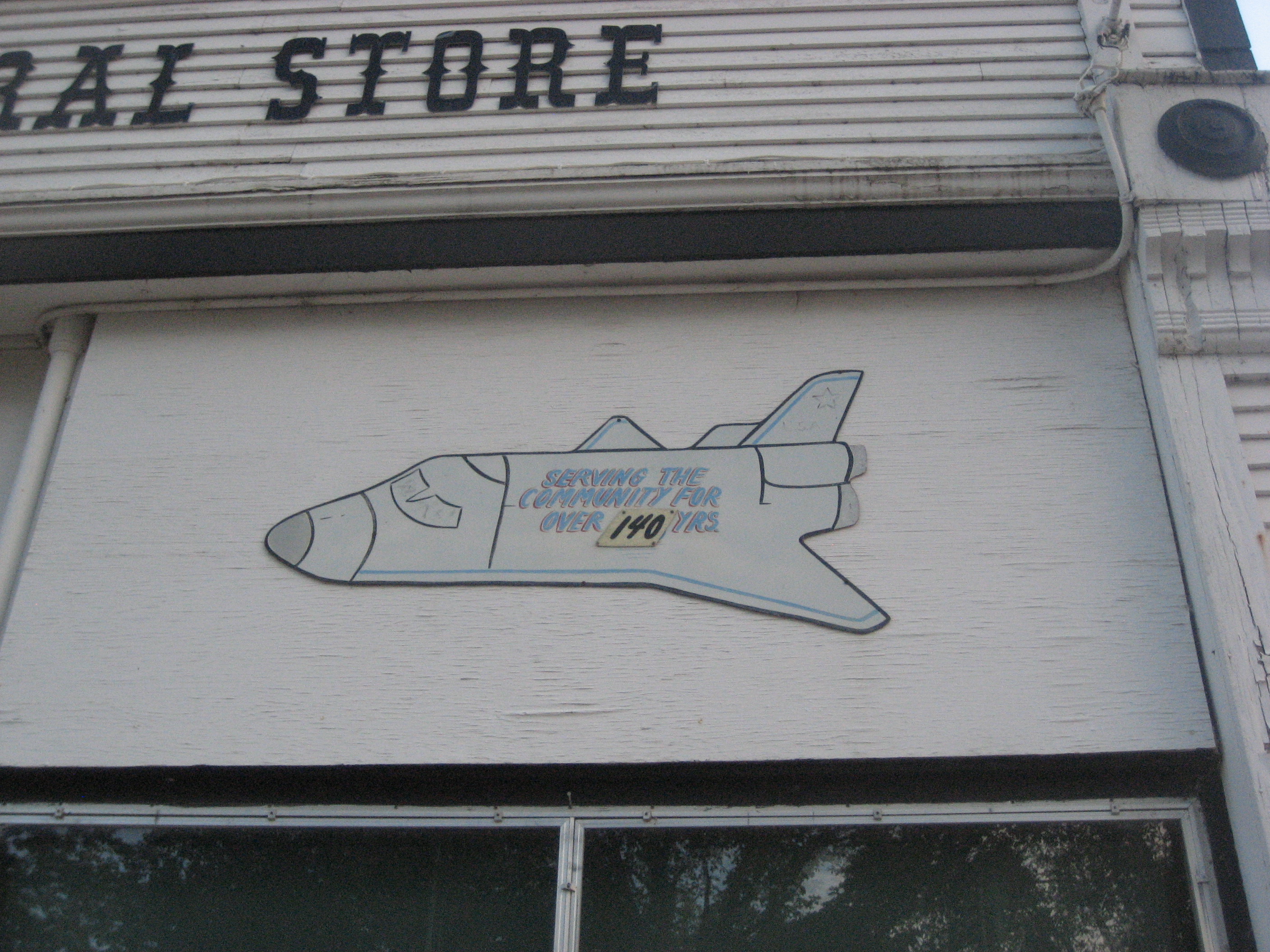
My grandma’s local general store, which closed down after 140 years.

Apricot Corn Flake French toast, my foodie sister-in-law has informed me, is still a very cool, very contemporary thing to make today. From the September 1966 issue, no. 12, vol. 31, page 30: “You’ll have many calls for seconds for this Apricot Corn Flake Toast” — 2 eggs, ½ cup apricot nextar; ¼ tsp salt, 8 slices day old bread, 3 cups corn flakes presweetened and crushed to make 1 ½ cups, 2-3 T butter or margarine: Combine eggs, apricot nectar and salt; beat. Dip bread slices in egg mixture, then cover both sides with cereal crumbs. Pan fry in butter or margarine until lightly browned and crisp on both sides, turning once. Serve hot with syrup, jelly or confectioners’ sugar. Yields 4 servings. 

IMG_4575

My daughter taking pictures at great grandma’s farm.

The life and death of an heirloom

25 Friday Jan 2013

Posted by theknittedword in American history, Art, Craft magazines, Knitting History, Uncategorized, Women's history

≈ 1 Comment

I’ve been looking through some American craft magazines from the 1940’s, 50’s and 60’s and marveling at the changes in our culture since they were published: there are numerous patterns for lace doilies and lace edging for women’s handkerchiefs, advertisements for wonderful new types of synthetic yarn, and articles about how to make money by recycling tin cans into plates or selling mail-order greeting cards. It makes me wonder, what happened to all of the things that the readers – like my grandmothers and great grandmothers – might have made from these magazines?

I suppose they could have ended up in Mike Kelley’s 1987 piece, “More Love Hours Than Can Ever Be Repaid,” which I saw in the 2011 Walker Art Center exhibit The Spectacular of the Vernacular. I went there to see two beautiful sculptures by my brother, Aaron. The exhibit “considers how artists have claimed homemade handicrafts or rustic aesthetic traditions in new ways.” (PBS.org) Kelley did that with his huge tapestry of old, discarded hand-made dolls, stuffed animals and afghans.

To me, his piece was looking at and questioning the value and necessity of homemade things in our culture. As a life-long knitter, I took it personally. The bears and afghans were familiar and reminded me of the crocheted and knitted things my grandma, neighbors, and other family friends made for me and my brothers in the 1970’s and 1980’s. More importantly, only a few weeks before seeing the Walker exhibit I myself had given a hand-knitted bunny to my four-year-old daughter for Christmas.

IMG_2782

While my daughter liked receiving it – she proudly remembered me working on it – I noticed several days later that she hadn’t played with it yet, even though the wool was locally spun (Bemidji Woolen Mills); the dress was made from luxurious, somewhat expensive alpaca yarn; and I had spent hours making a swatch, planning out the yarn, and knitting and piecing it together (I hate piecing). It had been a labor of love for my child. But despite my best efforts, the bunny didn’t really turn out to be as “good” as store-bought: it wasn’t as soft and cuddly as her plush bears, it had no buttons or batteries. So when I saw Mike Kelley’s piece, I wondered: will my daughter’s little bunny end up discarded like these other imperfect, scratchy homemade bears and blankets? What becomes of the imperfect, useless, scratchy, acrylic or wool hand-made things when there are perfect, shiny machine-made products that often become more loved, more used, more necessary to our daily lives? Is there a general lack of quality craftsmanship that is missing in our craft culture in America, where just the fact that something is handmade and not made at a factory makes an item not only a novelty but an heirloom as well?

These questions, I suppose, compel me to try to make things better. That is, if I can make something that is really beautiful, really special and fits just perfectly, it will be as good as factory-made and store-bought and will be loved and used – and keep it from ending up in the dustbin. Ultimately, though, I’m going to say that it doesn’t really matter what happens with my knitting after I’ve finished it and given it away. I love the knitting process and the moment of giving something I’ve made, and of course I would like to know the person appreciated it and could use it. But after I’ve given it away, it is no longer for me to decide. And I am only as good as my latest work, right? So I will keep trying to make better bunnies and socks and scarves…

And as for my own family’s many “heirloom” sweaters, afghans and doilies, I am happy to say that, after a few button and stitch repairs and despite the fact that they are acrylic (I prefer wool) my husband’s grandma’s sweaters keep us beautiful and warm all winter and my grandma’s afghans keep my daughter cozy at night. The dozens of my grandma’s colorful and intricate hand-crocheted doilies, however, remain piled up in the drawer of my china cabinet. At least they have each other’s company: the bunny remains on my daughter’s dresser, well dressed, but alone.

Twofers

29 Thursday Nov 2012

Posted by theknittedword in Knitting History

≈ 2 Comments

Double-pointed needles have officially taken over all of this year’s Christmas-gift knitting, as well as any bit of my free time: Now that it’s the end of November and I have time for only one or two more knitting projects to give, I have been knitting constantly and obsessively – knitting for a deadline puts me in a crazed state – and so I am cutting back on my knitting-reading for the time being and am only letting my fingers change pace here to do a bit of typing. Then back to knitting. 

I am determined to not repeat the same mistake I made the last two years by finishing my gifts only minutes before wrapping and giving (and sacrificing  the time for much-needed blocking).  Couldn’t I just make a whole bunch of small things? I made one lavender-filled sachet, above, from the book “More Last-minute Knitted Gifts” by Joelle Hoverson (STC Craft, New York: 2010), but after finishing it I felt dissatisfied: I wanted to make something more substantial for my recipients, like a hat or socks.  There is a beautiful pair of socks later in the book, also using DPNs. And there is my friend Leora’s  several Rowan and Kim Hargreaves books which she lent me recently and which have the most fashionable hats, of course (and where I could apply my DPNs).

“Robin” beret from “Thrown Together,” by Kim Hargreaves (Kim Hargreaves, 2008). The pattern asks for Rowan Classic Cashsoft 4ply but I used a very soft Dalegarn wool. 

So my new gift plan is set. But why double-pointed needles? Why torture myself with sharp needle points poking into the palm of my hand, stitches threatening to surreptitiously sneak off either end, tiny 0’s and 1’s bending and breaking under the strain?  And then there is the ubiquitous – condescending? – reminder in all such patterns: “Be careful to not let the stitches twist when casting on” (as if we had any control over such rogues).  All of this to avoid sewing. And to not have to purl so much… But there’s more to it than that, I think.  More than just getting the use of two needle points for the price of one (twofers!). I realized why I like DPNs – that I romanticize them, I suppose –  while recently browsing my latest knitting-history book, “Knitting America,” by Susan M. Strawn (Voyageur Press, 2007).  Double-pointed needles were really the only way to knit in the past, as you can see in the book’s 19th and 18th century grainy, spotted black-and-white photos: women wearing their Sunday best and sitting formally in carved wooden chairs, or in their aprons and sitting on the porch or in a field, are holding knitting that is always double-pointed, in-the-round.  They bring to mind one of the oldest pictures of knitting which dates to the beginning of the 1400’s and shows the Virgin Mary knitting, of course, with DPN’s in the round (Madonna Knitting, by Bertram of Minden). So when I knit with these needles too, it seems there is some connection I have with knitters of so many centuries ago. There is something rustic and genuine about knitting with something so simply made out of wood; maybe the struggle with the points and stubborn stitches makes it more so.

IMG_4932So the hat has turned out beautifully, as seen above.  Unbelievably – or not, really – I have to admit that I didn’t read the pattern very well and only assumed I was to knit the hat in the round. It turns out that the directions are to knit flat and sew up. The only problem I see with my hat is that at the corners where the needles met, and where the stitches were stretched out a bit, there is the slightest jog at the ends of the purled rows. Other than that the hat just needs the pom-pom on top (the color to be determined by my recipient’s coat). Incidentally, I do have a similar yarn in red: I’d have to transpose the pattern for the larger gauge, but the hat is so cute and was such a delight to knit that I would do it again. Maybe I should have done some double knitting while using my double-pointeds? Now that would have been a real Twofer.

Enter your email address to follow this blog and receive notifications of new posts by email.

Archives

  • March 2016
  • November 2014
  • October 2014
  • September 2014
  • September 2013
  • July 2013
  • June 2013
  • April 2013
  • March 2013
  • February 2013
  • January 2013
  • December 2012
  • November 2012
  • October 2012
  • September 2012
  • August 2012

Topics

  • American history
  • Art
  • Article review
  • Book review
  • Craft magazines
  • DPN's
  • Family history
  • Felt
  • Flax
  • Indiana
  • Industrial Revolution
  • Knitting History
  • Latvia
  • Minnesota
  • New York City
  • Pattern
  • Pottery
  • Recipe
  • Russia
  • Scandinavia
  • Sheep
  • Socks
  • Spinning
  • Translations
  • Uncategorized
  • Weaving
  • Women's history

Blogs I follow

  • carolynmaurice
  • mauricesgarden
  • Norway. Meaning?
  • Max Schireson's blog
  • Weaving Gifts Together
  • domaphile
  • ClothRoads
  • Gather
  • wool&gathering
  • JjD
  • Antris Blog
  • PRACTICE SPACE
  • KDD & Co
  • The Domestic Soundscape
  • sourtoothjournal.blogspot.com
  • The Knitted Word

Some interesting websites

  • ClothRoads “Our Mission: Creating opportunities for supporting indigenous textile artisans worldwide.”
  • Thrums: A world of textiles in books and other media
  • Bloc Socks: “Tell Your Feet the Cold War is Over”
  • Musturs: Adītāju klubiņš / Knitters club
  • Unbored: The Essential Field Guide to Serious Fun
  • Meisterdarbs: A knitting website, this page lists the most interesting Latvian hand-craft blogs

Interesting books

Meta

  • Create account
  • Log in
  • Entries feed
  • Comments feed
  • WordPress.com

Create a free website or blog at WordPress.com.

carolynmaurice

This WordPress.com site is our trip to SE Asia/November 2012

mauricesgarden

Norway. Meaning?

Max Schireson's blog

Thoughts on technology and the tech business

Weaving Gifts Together

domaphile

ClothRoads

Gather

:handmade shoppe & Co:

wool&gathering

Knitting, design, wool and other gatherings....

JjD

Antris Blog

Rokdarbi

PRACTICE SPACE

KDD & Co

Award-winning Scottish publishing and design

The Domestic Soundscape

making, listening, thinking

The Knitted Word

Privacy & Cookies: This site uses cookies. By continuing to use this website, you agree to their use.
To find out more, including how to control cookies, see here: Cookie Policy
  • Subscribe Subscribed
    • The Knitted Word
    • Already have a WordPress.com account? Log in now.
    • The Knitted Word
    • Subscribe Subscribed
    • Sign up
    • Log in
    • Report this content
    • View site in Reader
    • Manage subscriptions
    • Collapse this bar
 

Loading Comments...