• The knitting experience in culture, history, and daily life

The Knitted Word

The Knitted Word

Category Archives: Book review

Finding a gem at grandma’s house

17 Sunday Mar 2013

Posted by theknittedword in American history, Book review, Craft magazines, Knitting History, Minnesota, Pattern, Recipe, Women's history

≈ 1 Comment

IMG_4577

Exploring at great grandma’s farm.

It is hard not to find myself exploring at my grandma’s large, old farm house in southern Minnesota, a place that once housed my grandparents, their five children, their in-laws, and a great aunt. It is a house that has names for the rooms: the girls’ room, Olga’s room, the Mystery room, great grandma and grandpa’s room. Even when full of guests for the holidays I can easily find myself alone in a room full of my family‘s history in books, sheet music, clothes, toys, and blankets.  My grandma loves history too, and going through closets she often finds old family treasures, like long-lost letters and pictures she had almost forgotten about.

On my last visit, knowing my interest in knitting my grandma showed me a small collection of pocket-sized craft magazines from the 1950’s and 60’s which her mother-in-law had subscribed to, called The Workbasket. She let me take some home, and I realize now that I assumed they would not really be of much value to my knitting except as a token of history. My assumption has partly proven true: so many things are just not my style or are totally unnecessary in the 21st century. There are patterns for crocheted doilies to protect the back and arms of your couch or to protect your tables, for hand-made lace to edge your pillows, for hand-crocheting bands to hold together your linens nicely, for tatting the edges of your handkerchiefs. The February 1956 issue has one pattern for handkerchief edging that “will really be a conversation piece if worked in two colors” (vol. 21, no. 5, page 30). Ah, now if only I had a handkerchief… Some of the advice is silly, today:  “Saran Wrap,” they write, “the clear plastic film, is a wonderful help in storing sweaters, afghans, stoles and other woolens.” And when your knees need a break from gardening? Sew your old shoulder pads into the knees of your gardening slacks!  Imagine Martha Stewart telling readers to do that, or to add rotted manure or dried cow manure to houseplants to help them grow better. Or to sell greeting cards to friends and neighbors to make money for yourself or as a fundraiser for your church: in the January 1956 issue (vol. 21, no. 4) I found no fewer than eleven large ads for how readers can do this and “make $50 to $250 or more in your spare time – without any experience!”

IMG_4587

The local General Store, closed for a few years now but still stocked with cards.

Handkerchiefs, shoulder pads, slacks, ads for inexpensive accordions and Orlon, an acrylic/polyester/vinyl yarn that is now discontinued, black-and-white photos, the tiny print, the rough, yellowed paper – the magazine is definitely dated. But it’s not useless, not at all. There are so many gems I found in these journals, like the adorable crocheted belt in the June 1955 issue and the round knit rug, pattern below, which I am adding to my knitting to-do wish-list.  I am always keeping an eye out for pretty knitted summer sweaters and I happily found one with raglan sleeves and a buttoned placket in the August 1965 issue. Of course, I have to watch out for the details in these older patterns. Often the exact type of yarn is not given (the January 1956 cover sweater pattern gives only, “a deluxe sock and sport yarn was used to make this model”), and  the sizing is something to watch out for too: a small is bustline 32; large is bustline 36.  Otherwise, there are just different types of patterns to be found in this magazine. Today in knitting magazines I see patterns for hats, socks, scarves and sweaters; in these magazines from 1955, 1956, and 1965 I see place mats, rugs and sweaters. I was surprised to see that so many patterns required size 10 needles. I had assumed that this larger needle was a contemporary phenomenon.

The Workbasket started in 1935 and ceased publication in 1996, and during that time fashion and technology evolved dramatically; the change is clear even in the brief span of issues that I have, 1955-1965. In the 1955 and 1956 issues, the only color is on the cover in the template background; by my August 1965 issue, models are posing in their hand-knit sweaters in full color on the cover and sometimes inside. I still found doilies and one recipe asking for graham flour (a rarity in grocery stores today) in the 1965 issues, but gone are the card-selling advertisements and the money-making opportunities for stay-at-home women. Instead of the delicate doily place mats in the earlier issues, I found a beautifully knit place mat in April 1966 (vol. 31, no. 7, page 11) that is pretty and practical and could easily be found in a contemporary knitting journal. On a side note, I thought it was interesting to see that pink was definitely being marketed for girls in one 1966 issue: a pink-knit dress for an infant is called a “lovely little dress for some precious princess,” (More on the transition from blue to requisite pink for baby girls in the United States at: http://www.pinkisforboys.org.)

With recipe, home, garden sections and fun, quirky ways to repurpose older things, The Workbasket is, I suppose, one of the predecessors to Country Living and Martha Stewart (though in today’s magazines the ideas are less quirky and more snarky, which is getting boring to me). Exploiting and promoting the importance of home in our lives and culture, these journals are a source of ideas for women who want to beautify and update their homes and lives and families with creativity and individuality and thrift and the latest fashions. One commentator on one of the many websites devoted to The Workbasket thought that this type of journal in the 1950’s was a sign to women to stay at home and “stay in their place.” That’s tough for me to agree with. I love these types of magazines and see so much creativity and ingenuity in them, though even more so in The Workbasket than in today’s more sleek, polished, and generic magazines. I can’t help but think that this journal for that period in time was providing a space and platform for women to explore their creativity while raising kids and taking care of hearth and home, whether they wanted to or had to or felt compelled to. Based on the great number of money-making schemes in these journals, I can see that this was a magazine for women anxious to earn money; based on the great variety of ideas for how to reuse and create things, I can see that the readers were anxious to be creative, inventive, useful, and efficient.

Thinking of these magazines in history, I am reminded of how women were negotiating the new roles they found themselves in by the middle of the 20th century – new roles, yes, because the decades that their mothers and grandmothers were raising kids were so completely different from this. Who else did they have to learn from? The women in the 1930’s and 1940’s could not look back at how their mothers raised them in the 1910’s and 1920’s to figure out how to navigate this new era of canned soup and pudding mix and Orlon and higher expectations for hosting and cleanliness. (Can you tell I’ve been influenced by Ruth Schwartz Cowan? She wrote “More Work For Mother: The Ironies Of Household Technology From The Open Hearth To The Microwave” and talks at length about how expectations have been growing for the average women in the home, even as there is less help to do it.) And so while I have scoffed at the elaborate doilies and hand-croched bands to wrap one’s neatly folded linens, I also love the relatively easy way that women could bring in little touches of sophistication, of refinement, to their newly modernized homes while managing food and home and children and working, teaching piano, doing farm chores, or raising money for school. Even my history-loving grandma, who is 92 and a devoted musician in love with her piano, has delighted me by giving us all hand-embroidered towels as gifts. Where does she find the time, I wonder?

By the way, I’m not the only one not untouched by my grandmother’s craftiness: while reading a feature about a textile artist in the February 2013 Martha Stewart, the featured artist was asked for the inspiration behind her witty, whimsical, artful creations. Her answer? “My grandmothers tatted or made their own dolls or nutty puppets,” she said. Exactly.

Round Knit Rug, from the June 1955 issue, Vol. 20, no. 9, page 14-15: Rug yarn and number 10 wooden knitting needles were used in making this simple wedge pattern. The completed rug may have 11 or 12 wedges in all. It may be made any size and may be made oval if desired by knitting full length rows for sides. Abbreviations: K (knit); p (purl); sts (stitches); rnd (round). Cast on 48 sts (or any multiple of 3 depending on size desired).

Rnd 1: K 6, p 3, turn.
Rnd 2: K 9.
Rnd 3: K 6, p 6, turn.
Rnd 4: K 12
Rnd 5: K 6, p 9, turn.
Rnd 6: K 15.
Rnd 7: K 6, p 12, turn.
Rnd 8: K 18.
Rnd 9: K 6, p 15, turn.
Rnd 10: K 21.
Rnd 11: K 6, p 18, turn.
Rnd 12: K 24.
Rnd 13: K 6, p 21, turn.
Rnd 14: K 27.
Rnd 15: K 6, p 24, turn.
Rnd 16: K 30.
Rnd 17: K 6, p 27, turn.
Rnd 18: K 33.
Rnd 19: K 6, p 30, turn.
Rnd 20: K 36.
Rnd 21: K 6, p 33, turn.
Rnd 22: K 39.
Rnd 23: K 6, p 36, turn.
Rnd 24: K 42.
Rnd 25: K 6, p 39, turn.
Rnd 26: K 45.
Rnd 27: K 6, p 42, turn.
Rnd 28: K 48.
Rnd 29: Work same as rnd 1. This begins the second wedge.

Make 11 or 12 wedges in all. Sew last row to the first row. Bind off on a knit round.

IMG_4594

My grandma’s local general store, which closed down after 140 years.

Apricot Corn Flake French toast, my foodie sister-in-law has informed me, is still a very cool, very contemporary thing to make today. From the September 1966 issue, no. 12, vol. 31, page 30: “You’ll have many calls for seconds for this Apricot Corn Flake Toast” — 2 eggs, ½ cup apricot nextar; ¼ tsp salt, 8 slices day old bread, 3 cups corn flakes presweetened and crushed to make 1 ½ cups, 2-3 T butter or margarine: Combine eggs, apricot nectar and salt; beat. Dip bread slices in egg mixture, then cover both sides with cereal crumbs. Pan fry in butter or margarine until lightly browned and crisp on both sides, turning once. Serve hot with syrup, jelly or confectioners’ sugar. Yields 4 servings. 

IMG_4575

My daughter taking pictures at great grandma’s farm.
The Golden Age of Homespun

28 Sunday Oct 2012

Posted by theknittedword in Book review

≈ 1 Comment

In my last post on Swedish knitting I suggested that my next read would be on knitting in New Zealand. But another book caught my eye recently, one about the life of American pioneers, and I haven’t been able to shake it.  I intended for this blog to be mostly about foreign things – posts in other languages or knitting traditions from around the world – but I’m also a girl from a small, Midwestern town, and I think about it constantly: about what kind of place it is, about how culture and community grow there, about how it compares to other places here and abroad.   

So it was fitting that I found this book at a used book store in what I consider the capital of Midwest America – Chicago, were I was visiting last January to help my sister-in-law with her research on Midwestern food and cooking. By “help” I mean that we had to eat at several of the loveliest (relevant) restaurants within a matter of a long weekend. By the time we got to Avec, I couldn’t bear the thought of even one bite of the pièce de résistance – chicken with pomegranate sauce – much less my usual love, dessert. It was a kind of torture. In between eating, we walked. I was happy to be kid-free for a few rare days and I relished the selfish, decadent time. A book store was the perfect destination for us: we could get lost in our own thoughts, in our own books, killing time until our next meal reservation. With that kind of open, luxurious time, I was desperate to sink my teeth into something fulfilling, something about my great loves of knitting or languages ideally, when I happened upon this grand title bound in mustard-yellow cloth: “The Golden Age of Homespun” by Jared Van Wagenen, Jr. (Cornell University Press: Ithaca, New York. 1953.). 

Reading “The Golden Age of Homespun” is like having a guided tour through an antique shop or a farming history museum. Our guide – who wrote the book at age 82 – fondly relays the stories told to him by his parents, grandparents, and other old-timers about what life was like during the earliest colonial period, through the pioneering days, and up to the Civil War and the beginning of the machine age. He defines this era in terms of home-processed textile because the art of processing one’s own yarn and fabric became essentially lost at the end of this period. While other farming tools and practices of the time were recorded in farm journals and while kitchen and cooking arts continued into subsequent generations, the art of making fabric at home died with the advent of machines. He writes (and you can see how pleasantly he writes):

“I have not found it possible to gather much information relative to the precise technique of the domestic manufacture of wool. Those elect women who were with us when the homespun age drew to a close and who could have been given such ample and illuminating testimony have since gone the way of all the earth. In the great libraries are shelves of books dealing with modern woolen manufacture, but only here and there can be found a phrase that has any reference to the homespun art. While our earliest periodical agricultural literature has a great deal to say concerning the care and breeding of sheep, it has hardly a word concerning the manufacture of their fleeces. It is a melancholy reflection that a great amount of skill and knowledge concerning one of the most fundamental of household arts has left behind no written word or even tradition.” (page 261; my italics)

His references to census statistics show the extent of the work that women were doing at this time. The 1845 census shows that more than seven million and ninety thousand yards of cloth had been woven at home in the previous year (p.266). (Throughout the book he generally talks about New York state, where he and his family farmed). Also according to the 1845 census, pioneers in New York State grew 46,000 acres of flax; by 1855 it dropped to 13,000 acres and after the Civil War it was not a significant crop in the census any more (p.251). Cotton of course replaced linen around the time of the Civil War; cotton was cheaper and easier to grow and to process on machines.

I think what strikes me here is the same theme I ended with in my last post on knitting history, that is, the failure of historians to capture the everyday work of women in history.  The author of “The Golden Age of Homespun” defines an entire age by what was largely women’s work. The transition to purchased cloth from homespun was dramatic and completely life changing for women, and consequently the whole family: whereas families once grew their own flax and raised their own sheep in order to spin the fibers into yarn to be woven or knitted into their family’s clothing, there came a point where it was more economical to make money for purchasing cotton cloth already made. How much activity and daily life changed within a matter of decades! And how little we know about it today!

By the way, speaking of purchased, machine-made cloth, that was the other thing that my sister-in-law and I did in our beloved Midwestern mecca: browsed vintage clothing stores. I was happy to find, in all of my luxurious, non-spinning, non-weaving, non-child-rearing time, a fun little inexpensive top made out of rayon, the natural but laboratory-made fabric that the pioneers certainly would have marvelled at. They, like me, would have also marvelled at the chicken with pomegranates, the memorable Wild Boar Sloppy Joe at Longman & Eagle, and the “fried naked cowboy” egg salad (with oysters) at The Girl and the Goat. 

Exclusive hand-knit sweater!

26 Wednesday Sep 2012

Posted by theknittedword in Book review, Scandinavia

≈ 1 Comment

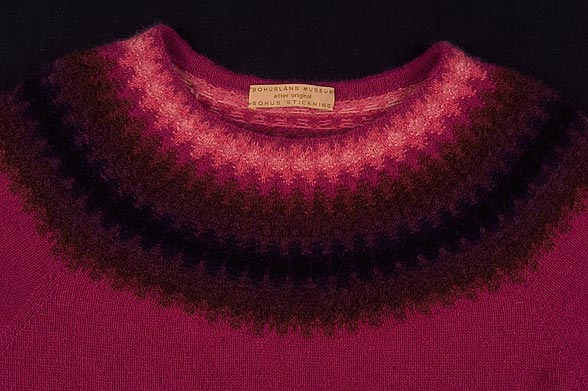
“The Red Palm” Design: Kerstin Olsson, 1967; picture posted with permission from Bohusläns Museum

Last week I opened up the most recent Garnet Hill catalogue and saw a gorgeous bobbles & lace knit sweater next to this caption: “E/Hand-Knit Sweater EXCLUSIVE Lusciously soft Italian blend of acrylic/wool/viscose/alpaca… Italy/Imported….#27525 $88.” It makes me want to know – just who is hand-knitting these sweaters for such a low price? Or is that just the name of the “style” of this sweater… After I count up the hours it takes me to actually knit something – I’m a moderately fast knitter when I get going – plus the time in designing or just making a gauge, plus the cost of the yarn: it is priceless!  (Something I usually only start to realize when buying insurance for my precious hand-knitted items to be sent in the mail.)

The subject of hand-knitting for sale brought to mind the knitting book I most recently finished: Wendy Keele’s history of “Bohus Stickning,” a Swedish knitting business that created so many beautiful and unique hand-made sweaters from the 40’s through the 60’s.  The business was started for women in rural, southern Sweden (Bohuslän) who were struggling to make ends meet following the depression. In 1937 the women approached Emma Jacobsson, the wife of the governor of Bohus, to look for a cottage industry for the women to make money while taking care of their children, homes and farms. Emma settled upon knitting, something that the women in this region could already do and that required few tools. She found innovative designers and encouraged them to create new, interesting, and fashionable sweaters, hats, and mittens that were eventually marketed around the world, most importantly to wealthy foreigners. She demanded the highest quality of wool, paying higher than usual prices to the best wool producers, and she demanded perfection in the actual knitting and sizing. Bohus Stickning grew and thrived as the economy improved in the 1950’s, but by the early 60’s demand fell and in April 1969 Bohus ceased operations.  So much had changed in that period of time as cheaper, machine-made sweaters became much more easily available and fashions and styles had evolved.

While reading I was struck by the story of the women who actually did the knitting.  After Bohus closed, some of the knitters wrote letters of gratitude for Bohus and all that it gave them. One wrote, “It will be a big loss not to get Bohus knitting anymore. It had been so interesting and nice when sitting alone…” (Keele, page 51). This lovely glimpse into domestic life of the past is something that I think about often as I raise my two children and struggle to meet that happy point between taking care of them and meeting my own professional, personal, financial, etc. needs.  I wonder how my ancestors – several of them from nearby Norway – managed to cook and preserve and farm while raising children who constantly get into things and need so much. On top of all of that, the Bohus women were knitting perfect sweaters for others to make a little extra money; they were docked pay when the sizing was off or there was a mistake in the pattern, Keele writes. When I read political histories about important actors and decisions, I miss this part of the story – the day-to-day life of people in a particular time and place, especially of the people taking care of hearth and home.

The larger history during this time and place is striking too: Bohus Stickning was founded in September 1939, the year that Germany invaded Poland and effectively started World War II in Europe.  If Sweden would have taken sides in World War II – the country was neutral – the knitted goods made by Bohus Stickning most likely would have supported the war effort. Of course Bohus was not unaffected by the war, Keele explains; at one point the Swedish government required a permit for wool to be exported and spun in Finland where Emma sent some of her finest wool; later, the Finnish government banned all wool exports. Still, I can’t help but think of the home knitters in New Zealand during World War II who supported their troops by knitting them thousands of socks made from their country’s wonderful wool of course. (I read about this in Heather Nicholson’s book, The Loving Stitch: A history of knitting and spinning in New Zealand, published by Auckland University Press, 1998.) How differently Bohus Stickning might have developed – how different those women’s lives would have been! – had Sweden changed political course.

From Garnett Hill, to Sweden, to domestic life, to politics, and now to New Zealand. It looks like I’ve chosen my next book to read!

Photo used with permission from Interweave Press. Photo by Joe Coca, © 1995 Interweave Press and Joe Coca, http://www.interweavestore.com/store/Search.aspx?SearchTerms=Keele

“Poems of color: knitting in the Bohus tradition,” Interweave Press, 1995; by Wendy Keele  http://www.interweavestore.com/Knitting/Books/Poems-Of-Color.html

Enter your email address to follow this blog and receive notifications of new posts by email.

Archives

  • March 2016
  • November 2014
  • October 2014
  • September 2014
  • September 2013
  • July 2013
  • June 2013
  • April 2013
  • March 2013
  • February 2013
  • January 2013
  • December 2012
  • November 2012
  • October 2012
  • September 2012
  • August 2012

Topics

  • American history
  • Art
  • Article review
  • Book review
  • Craft magazines
  • DPN's
  • Family history
  • Felt
  • Flax
  • Indiana
  • Industrial Revolution
  • Knitting History
  • Latvia
  • Minnesota
  • New York City
  • Pattern
  • Pottery
  • Recipe
  • Russia
  • Scandinavia
  • Sheep
  • Socks
  • Spinning
  • Translations
  • Uncategorized
  • Weaving
  • Women's history

Blogs I follow

  • carolynmaurice
  • mauricesgarden
  • Norway. Meaning?
  • Max Schireson's blog
  • Weaving Gifts Together
  • domaphile
  • ClothRoads
  • Gather
  • wool&gathering
  • JjD
  • Antris Blog
  • PRACTICE SPACE
  • KDD & Co
  • The Domestic Soundscape
  • sourtoothjournal.blogspot.com
  • The Knitted Word

Some interesting websites

  • ClothRoads “Our Mission: Creating opportunities for supporting indigenous textile artisans worldwide.”
  • Thrums: A world of textiles in books and other media
  • Bloc Socks: “Tell Your Feet the Cold War is Over”
  • Musturs: Adītāju klubiņš / Knitters club
  • Unbored: The Essential Field Guide to Serious Fun
  • Meisterdarbs: A knitting website, this page lists the most interesting Latvian hand-craft blogs

Interesting books

Meta

  • Create account
  • Log in
  • Entries feed
  • Comments feed
  • WordPress.com

Blog at WordPress.com.

carolynmaurice

This WordPress.com site is our trip to SE Asia/November 2012

mauricesgarden

Norway. Meaning?

Max Schireson's blog

Thoughts on technology and the tech business

Weaving Gifts Together

domaphile

ClothRoads

Gather

:handmade shoppe & Co:

wool&gathering

Knitting, design, wool and other gatherings....

JjD

Antris Blog

Rokdarbi

PRACTICE SPACE

KDD & Co

Award-winning Scottish publishing and design

The Domestic Soundscape

making, listening, thinking

The Knitted Word

Privacy & Cookies: This site uses cookies. By continuing to use this website, you agree to their use.
To find out more, including how to control cookies, see here: Cookie Policy
  • Subscribe Subscribed
    • The Knitted Word
    • Already have a WordPress.com account? Log in now.
    • The Knitted Word
    • Subscribe Subscribed
    • Sign up
    • Log in
    • Report this content
    • View site in Reader
    • Manage subscriptions
    • Collapse this bar
 

Loading Comments...